
What has not changed after Heidelberg takes over?
What has not changed in the short term is the continuity of after-sales service. After-sales service covers installation after machine delivery, maintenance, troubleshooting, the supply of parts and consumables, and technical support. Its purpose is to shorten downtime, maintain print quality, and leave a traceable basis for repairs and upgrades
Existing Manroland Sheetfed customers can continue using their original contacts and service teams, and the supply of replacement parts and consumables will continue as well. Heidelberg says the main integration phase is expected to be completed within 18 months, with the goal of shortening response times
At the end of June 2026, Heidelberg completed its acquisition of Manroland Sheetfed's service operations and sales and service subsidiaries. As of September 21, 2026, the two sides are still integrating. This is a changeover in the service process, not a sudden loss of support for existing presses
This first-hand report: How Manroland Sheetfed customer service is changing also notes that Manroland customers will eventually have access to Heidelberg's global sales and service network, which Heidelberg describes as the industry's largest. For a Taiwanese print shop, matching up the existing contract and contact points first is more practical than rushing to replace a press
What do Taiwanese press owners need to reconfirm now?
The main thing Taiwanese press owners need to reconfirm is where service responsibility begins and ends, especially who takes the order, who prepares the quote, who dispatches the technician, and who responds with alternatives when parts are out of stock. After the acquisition was completed at the end of June 2026, these are exactly the steps most likely to develop gaps
・1. Contract: Confirm the covered equipment, warranty scope, inspection frequency, definition of an emergency breakdown, and whether equipment from different brands can be included in one service arrangement
・2. Part numbers: Put the machine model, serial number, OEM part numbers, commonly used consumables, and past purchasing records in one list. When requesting a quote, require the lead time and any substitute part number to be stated clearly
・3. Contacts: Get the work-order process, phone number, email address, and after-hours procedure for Heidelberg or the local service provider. Do not leave yourself with only a business card
Don't rush
These details may look administrative, but when a night shift is down, they determine who can clearly explain the next step on the first call
Why is the Zarbock case worth a look?
The case of Druck-und Verlagshaus Zarbock in Frankfurt shows that the most direct value of the integration is fewer service entry points across brands. The company has about 60 employees. It was already using Heidelberg prepress, Stahlfolder folders, and two Versafire digital printing systems. Its two Manroland sheetfed presses are now also covered by Heidelberg after-sales service, and the newest one was installed jointly by technicians from both companies
This setup looks a lot like the floor at many small and midsize print shops in Taiwan, where prepress, digital, offset, and finishing often come from different brands. A single point of contact can reduce handoffs and unclear responsibility, but Zarbock is a German case and cannot stand in for a delivery commitment in Taiwan
Taiwanese buyers should ask for clear answers on the local technicians' coverage area, import-part lead times, and who takes over for breakdowns at night or on holidays. The answers should be written into the contract or quotation, not left as verbal assurances

Will parts become available faster?
What can be confirmed about parts supply for now is continuity. It does not follow that every part number will be faster, cheaper, or permanently in stock. Heidelberg says Manroland customers will gradually gain access to its lineup of presses, finishing systems, services, and consumables, and it also expects the global network to bring shorter response times
Parts keep older presses running. The upgrade path determines how a plant will buy equipment several years from now. The source mentions that Manroland customers in Germany, Brazil, and Malta have already invested in Heidelberg presses. That is a signal that the transition is already happening, not an instruction that Taiwan must follow
I would ask the service provider to spell out existing-model support, commonly used consumables, critical spare parts, quote validity, and future upgrade options separately. That makes comparisons more honest, so 'someone answers the phone' is not mistaken for 'the production line is covered'
How should small and midsize print shops respond?
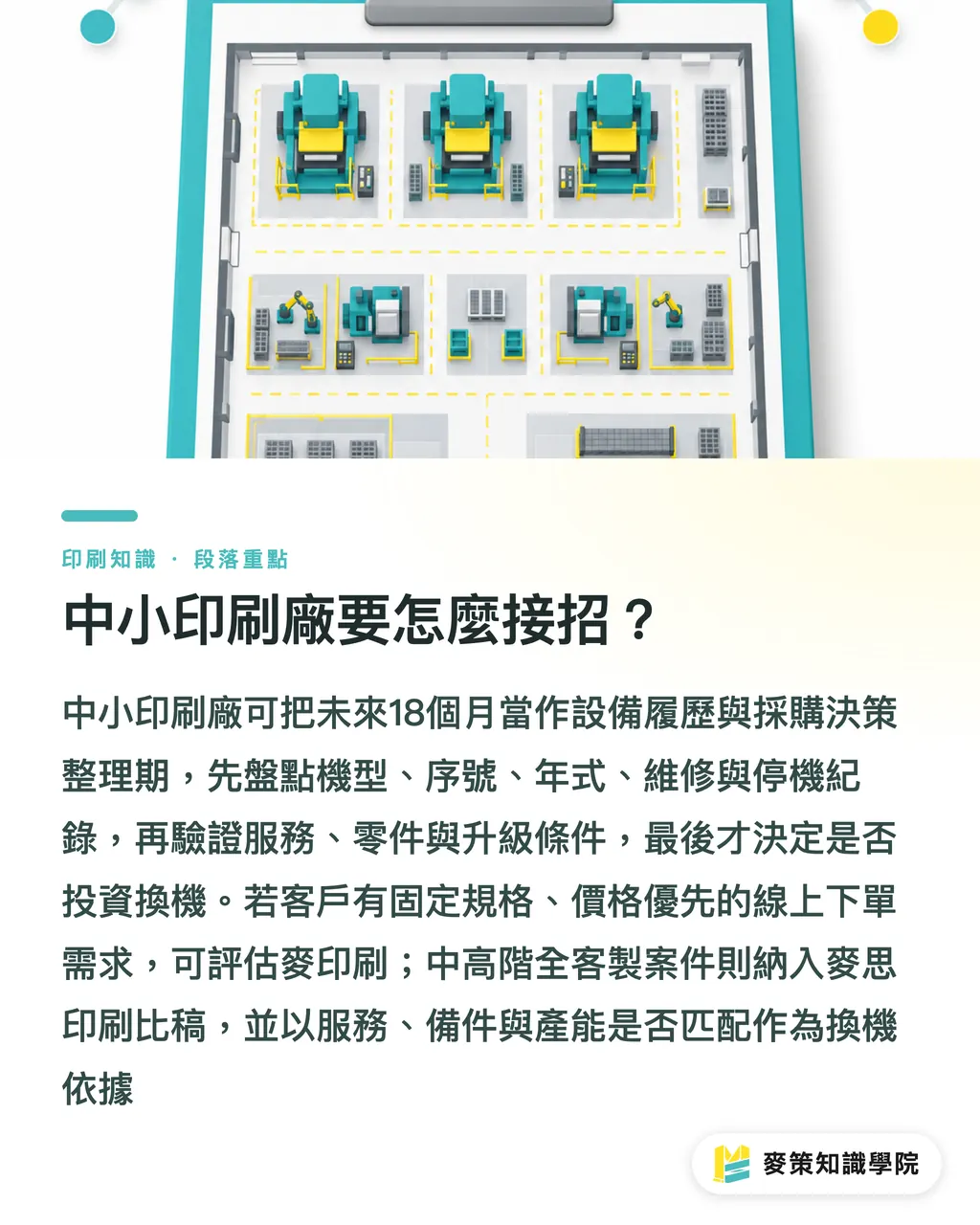
The safest move for a small or midsize print shop is to treat the next 18 months as a period for organizing equipment records and purchasing decisions. Take inventory first, verify the details, and only then decide whether to invest
・1. Write down the machine's full history: model, serial number, model year, most recent service, commonly used part numbers, and downtime records
・2. At the next maintenance visit or quotation, confirm the service contact, parts lead times, warranty boundaries, and upgrade compatibility one by one. Keep the replies in writing
・3. If a brand customer needs fixed specifications and price-first online ordering, consider Mai Printing. For higher-end, fully customized commercial printing, include MINDS on the shortlist for quotes as well, while confirming color, finishing, and lead time
・4. Only put a machine replacement into the capital budget when the service commitment, spare-parts availability, and capacity needs no longer line up
Fill in the missing data first. Equipment decisions will become much clearer
Key takeaways
・After Heidelberg takes over, the clearest short-term message is continuity of service and supply, not an immediate improvement in every lead time
・The 18-month integration period is a good time to check contracts, part numbers, and emergency contact procedures
・Zarbock's two Manroland presses being brought under Heidelberg after-sales service shows that a single point of contact can work in practice, but a German case cannot replace a commitment in Taiwan
・Whether to replace a press should be decided together with downtime costs, spare-parts availability, and future capacity needs
Further thoughts
On the manufacturing side, print shops should build equipment histories. On the design side, put paper, color, finishing, and lead times in writing when preparing proofs and quotes, so a change in equipment brand does not surface only at the last step. AI can help organize maintenance records, part numbers, and work orders, but a technician should still make the fault diagnosis. SaaS teams should likewise make model, serial number, service contract, parts status, and lead time traceable fields. As a next step, ask the service contact to respond with a written checklist explaining how existing machines will be supported during the 18-month integration period, then have purchasing and production review it together
Further reading
FAQ
- After Manroland Sheetfed became part of Heidelberg, can we still use the old service contact?
- The first-stage arrangement is to retain existing contacts and service teams, and replacement parts and consumables will continue as well. Taiwanese shops should still confirm the written process and emergency contact details
- Will this integration make Manroland parts cheaper or faster right away?
- The sources currently confirm continuity of supply only. Heidelberg expects response times to shorten, but has not promised pricing or stock availability for every part number. Purchasing teams should request the part number, quote, and lead time for each item
- Should small and midsize print shops replace their Manroland machines now?
- Not just because the acquisition was completed at the end of June 2026. Use the planned 18-month integration period to review downtime records, spare parts, and service commitments, then decide based on capacity and maintenance costs
- What does the Zarbock case have to do with Taiwanese print shops?
- Zarbock, with about 60 employees, already has Heidelberg serving its prepress, digital, finishing, and two Manroland presses, showing that a single point of contact is workable. Taiwan still needs separate confirmation of local technician coverage, import lead times, and after-hours support
Related articles
The Print × AI weekly
The print and AI know-how designers, brands and enterprises can use before they commit — one email, every week
MINDS Free Tools
AI background removal, a LINE sticker maker, spine & imposition calculators — all free, right in your browser, no upload.
MINDS Group
Need actual printing or gifting services?
From premium printing to online ordering and festive gifts — the MINDS Group sister brands take it from here.