
What Is Inkjet Printing?
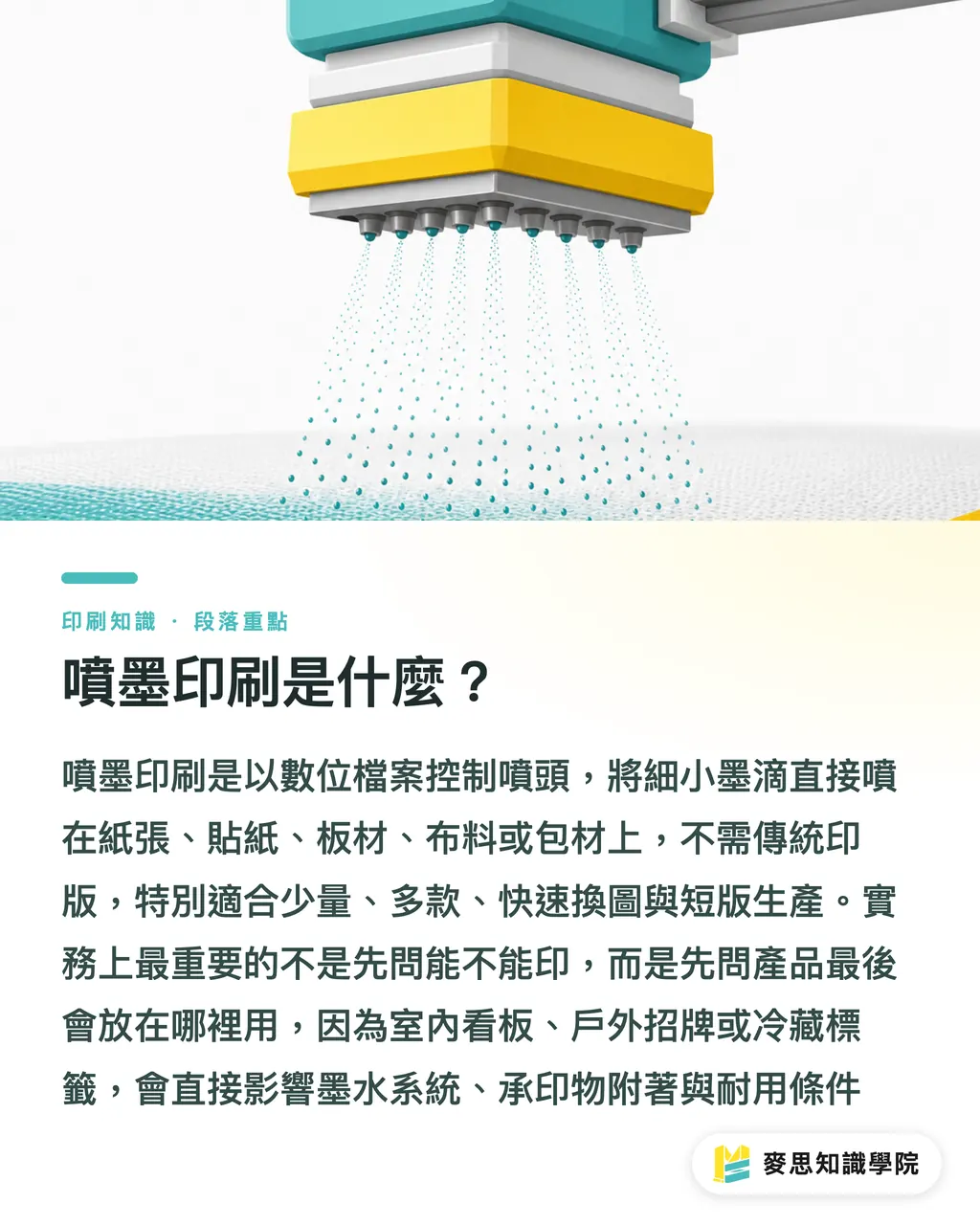
Inkjet printing means shooting tiny ink droplets directly onto a substrate through a print head, no traditional plates needed. It suits low-volume, multi-SKU, fast-changing print jobs. In MINDS (MS)'s day-to-day judgment calls, the first question to ask about inkjet is always: 'Where does this product end up being used?'
The core definition: inkjet printing uses a digital file to control print heads that shoot ink droplets directly onto paper, stickers, boards, fabric, or packaging surfaces. The ink then sets through air drying, heat drying, or UV curing
The logic is different from offset printing. Offset suits stable, high-volume runs. Inkjet suits fast image swaps, quick proofing, and short-run production. That's why, whether it's one poster, 50 display boards, or 300 stickers, inkjet often makes more intuitive sense than setting up plates
The one thing I always remind clients: inkjet isn't just a scaled-up home printer. Industrial inkjet involves at least three basic variables:
・Ink system: water-based, UV, solvent, and other systems differ in drying method, color output, odor, and weather resistance
・Substrate surface: paper, PVC, PP, acrylic, foam board, and corrugated all have different ink absorption and adhesion conditions
・End use: the durability requirements for indoor signage, outdoor signs, refrigerated labels, and short-run box sleeves are completely different
Which Products Work Best with Inkjet Printing?
The products best suited to inkjet share one thing: lots of variations, volume that isn't always large, tight deadlines, or a need to quickly test effects across different materials. Looking at typical purchasing situations for small and mid-sized businesses in Taiwan, I'd put four product categories at the top of the inkjet evaluation list:
・Large-format output: posters, backdrops, light panels, outdoor banners, vehicle wraps, good for large sizes, low quantities, or visuals that need to change quickly
・Display items: exhibition standees, event hero visuals, booth back walls, retail end caps, typical orders range from one to tens of pieces, with emphasis on visual impact and ease of installation
・Labels and stickers: product labels, bottle labels, logistics labels, event stickers, good for jobs with many SKUs, small batches, and content that changes often
・Short-run packaging: test-market boxes, sample boxes, small-batch branded packaging, seasonal limited-edition outer boxes, good for testing market response before committing to a full plate run
Large-format output is inkjet's most mature application:
・One reason: sizes often push past A 3 and A2, putting them outside what standard small-format equipment can handle. For designers working on an event backdrop, file resolution, viewing distance, and material selection matter more than chasing the highest DPI
Labels and short-run packaging have attracted noticeably more attention in recent years. The reason is simple: brands are running smaller test batches more often. A new drink might start with 300 labels to test sales. A gift box might start with 50 samples to show buyers. Inkjet gives these jobs a flexibility that's hard to match
For higher-end, fully customized commercial printing, full-suite exhibition output, specialty material short-run packaging, or brand visuals that need tight color control, it's worth having MINDS do a material and color assessment first. For standard-size stickers, posters, and small-run output, MINDS's online ordering flow is generally the faster route
What's the Difference Between Water-Based, UV, and Solvent Inks?
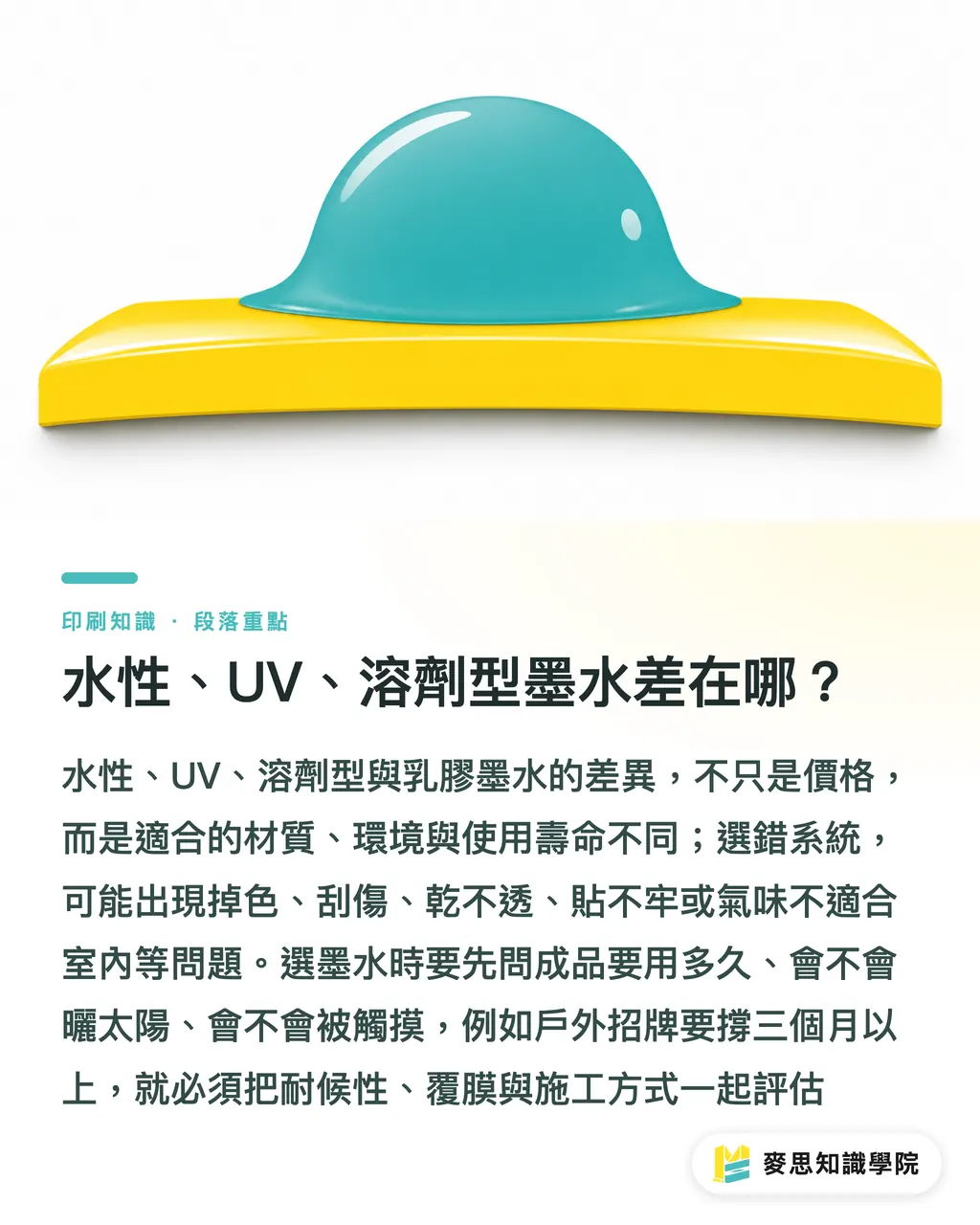
Water-based, UV, and solvent inks aren't just different in price, they have different temperaments. Pick the wrong ink system and the problems that follow are predictable: fading, scratching, ink that won't dry, poor adhesion, or a client opening the finished product and finding the smell isn't suitable for indoor use
・Water-based inks: refined color output, commonly used for indoor posters, photo paper, and fine art paper; watch for protection and lamination needs in humid or outdoor environments
・UV inks: cure quickly under UV light, work on more non-absorbent materials such as acrylic, PVC board, and metal-coated surfaces; the ink layer has a more noticeable tactile feel
・Solvent inks: common in outdoor advertising, banners, and vehicle wraps; better weather resistance, but watch for odor, ventilation requirements, and material compatibility
・Latex inks: often used for indoor and outdoor advertising output; relatively low odor, suitable for wall stickers, posters, and decorative output, though equipment and material pairing still matters
I treat ink selection as a practical question: How long does this print need to last? Will it see direct sun? Will it be touched? Will it go on a curved surface?
An indoor product launch backdrop might only run three days, water-based or UV output could both work. An outdoor sign that needs to hold up for three months or more needs weather resistance, lamination, and installation method all factored in together. A bottle label that'll get soaked in cold water means ink, adhesive, and surface protection can't be looked at separately
When Is Inkjet Printing the Wrong Choice?
Inkjet is flexible, but it's not a universal solution. When a job calls for very large volumes, extremely stable unit pricing, special metallic colors, long-term high-friction use, or high-speed integration with existing packaging lines, inkjet isn't necessarily the right primary process
I usually run through four questions to help clients catch problems early:
・Is the volume very large: for the same design printed in the thousands or tens of thousands, traditional offset, flexo, or screen printing may have a clear cost advantage
・Are the color requirements extremely strict: if brand standard colors need to be highly consistent across batches, proofing, color management, and tolerance confirmation need to happen upfront
・Is the surface hard to bond to: glossy plastics, special coatings, metal substrates, and rough corrugated all need adhesion testing first
・Is the end environment demanding: outdoor sun exposure, cold-storage humidity, friction during handling, and alcohol wiping will all amplify weaknesses in ink and material
A very common example: some clients bring corrugated board wanting high-saturation packaging graphics, and their first instinct is to ask whether it can just be printed directly. My experience is that the surface absorption, texture, and fiber condition of corrugated board eats into fine detail. Getting saturation and consistency both right may mean adjusting the paper stock, pre-coating, ink volume, or switching to a different process entirely
Designers need to watch out too: inkjet output doesn't mean what you see on screen prints exactly. RGB screens emit light. Printing reflects it. Fluorescent colors, neon effects, deep blacks, and large areas of flat gray all need a proof before you commit
What to Check Before Placing an Inkjet Order?
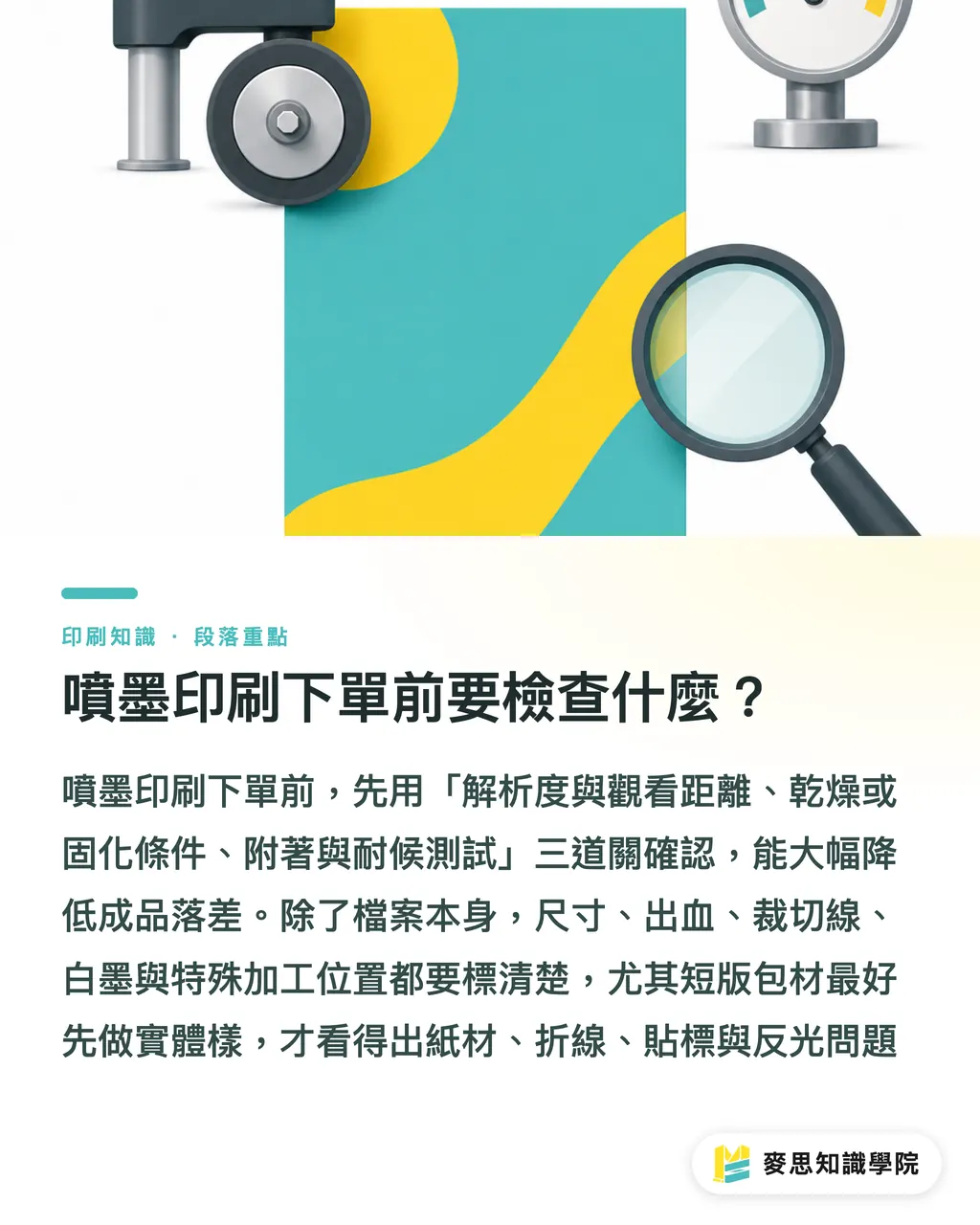
To get clean results from an inkjet job, run through MINDS (MS)'s three-gate pre-press checklist before sending files: ① resolution and viewing distance, ② drying or curing conditions, ③ adhesion and weather-resistance testing. Clear those three gates and most problems drop by half
・① Resolution and viewing distance: a close-range A4 sticker needs fine detail; a large backdrop is typically viewed from one to three meters away. Don't apply the same resolution logic to both
・② Drying or curing conditions: water-based output needs drying time and waterproofing; UV needs full cure confirmation; solvent needs evaporation time and post-processing wait
・③ Adhesion and weather-resistance testing: stickers need peel and scratch testing; outdoor pieces need sun and rain exposure testing; packaging needs fold, handling, and friction testing
Don't just send a single PDF and call it done. Inkjet jobs often involve large sizes, multiple materials, and multiple finishing steps. Designers should clearly mark dimensions, bleed, cut lines, white ink requirements, spot gloss positions, and any specialty material zones. One unclear white ink layer can easily burn half a day of back-and-forth on the floor
For short-run packaging, I'd recommend getting at least one physical sample made, especially for folding boxes, bottle labels, refrigerated food labels, and display stands. Screen proportions are easy to misjudge. Board stiffness, fold cracking, label curvature, and light reflection all need to be felt in hand to assess properly
Key Takeaways
・Inkjet works best for multi-SKU, low-volume, fast-changing products. Don't force it to compete on unit cost with large-volume runs
・Water-based, UV, and solvent inks each have their place. Choosing an ink is really choosing a drying method, an adhesion profile, and a durability level
・Large-format output, displays, labels, and short-run packaging are inkjet's four main arenas. Look at end use before looking at quotes
・Print quality isn't about the highest DPI. It's about getting resolution, material, viewing distance, and finishing all lined up together
・Run material tests before ordering. Many print problems aren't caused by the machine, the material was the wrong choice from the start
Further Thoughts
For print manufacturers, inkjet's value is in closing the gap between proofing and short-run production. For designers, inkjet means packaging, displays, and labels can move into physical validation faster. For AI and SaaS teams, the tools that actually matter aren't ones that just generate images. They're ones that can pull together product end use, material constraints, color risks, and pre-press checks into one executable workflow. The practical next step: split common product types into four categories, indoor, outdoor, adhesive, and packaging, and build a material whitelist, file spec, and proofing protocol for each. A lot of unnecessary rework disappears
FAQ
- What products is inkjet printing good for?
- Inkjet works well for large-format output, displays, labels and stickers, and short-run packaging, especially for low-volume, multi-SKU jobs with short lead times and content that changes often
- How is inkjet printing different from regular printing?
- Inkjet printing doesn't need plates, it shoots ink directly onto the substrate through a print head. Standard offset printing is better suited for large-volume runs of the same design; inkjet is better for quick proofing and short-run variations
- Is UV inkjet always better than water-based inkjet?
- UV inkjet isn't automatically better. It works on more non-absorbent materials and cures fast, but water-based inkjet still holds its own for indoor photo paper, posters, and fine color reproduction
- Can outdoor signage be printed with inkjet?
- Yes, but you need to confirm the ink system, lamination, material, and installation method. Sun exposure, rain, and abrasion all affect how long the finished piece holds up
- Why is inkjet commonly used for short-run packaging?
- Short-run packaging uses inkjet because it allows small quantities, fast revisions, and lower trial-and-error costs before committing to plates, making it practical for new product tests, buyer presentations, and seasonal limited-edition packaging
Related articles
The Print × AI weekly
The print and AI know-how designers, brands and enterprises can use before they commit — one email, every week
MINDS Free Tools
Spine width and imposition calculators — skip the manual math, free in your browser.
MINDS Group
Need actual printing or gifting services?
From premium printing to online ordering and festive gifts — the MINDS Group sister brands take it from here.