
Why EU Customs Are Cracking Down on Compostable Packaging Standards
In recent meetings with several clients exporting to Europe and the US, the biggest anxiety is no longer just quotes, but whether their packaging can successfully clear customs
The EU's Packaging and Packaging Waste Regulation (PPWR) explicitly mandates that specific categories must meet compostability standards by 2030
This means the old mindset of 'passive recycling' no longer works; what we are facing now is mandatory design scrutiny at the source
Compostability certifications such as Europe's EN 13432 and the US's ASTM D6400 are becoming trade barriers that impact the bottom line
If Taiwanese export brands still treat compostable packaging merely as a marketing highlight, they will undoubtedly suffer losses in their export orders for the second half of the year
How Compostable Film Technology Overcomes Mass Production Hurdles
In the past, the industry's impression of compostable packaging was mostly that it was expensive, difficult to process, or prone to weak seals and tearing
However, looking at the recent moves by international suppliers like TIPA, TotalEnergies Corbion, and Taghleef, the physical limits of materials are being rapidly broken
The iteration speed of current compostable films and sealing materials is extremely fast, and they are now capable of interfacing with large-scale commercial production lines
When major equipment manufacturers like Brückner Maschinenbau invest in mass-producing compostable packaging, it means the technology has long since moved past the laboratory stage
Just like our observations on the development trajectory of Lavazza's film-free technology or low-carbon aluminum, high-standard environmental requirements will eventually return to rewrite the hardware specifications of production lines
How Small and Medium-Sized Print Shops Should Respond to Compostable Materials
Once materials are changed, print shops must not remain passive recipients; they must actively assess their production line's processing limits and material compatibility
In practice, when converting to compostable packaging, the production side must keep a close eye on several key variables
・Ink Adhesion Performance: Compostable materials have different surface tensions, requiring re-testing of the drying speed and firmness of eco-friendly inks
・Post-Press Processing Substitution: Traditional plastic lamination destroys the overall compostability certification and must be replaced with compostable coatings or specialized water-based varnishing processes
・Seal Temperature Tolerance: The heat-sealing conditions for new films differ significantly from traditional PE films, and machine parameters must be recalibrated
If the cost of directly changing the entire packaging material is too high, I usually suggest starting by de-plasticizing small components like labels or caps; this is the quickest shortcut to obtaining a compliance report
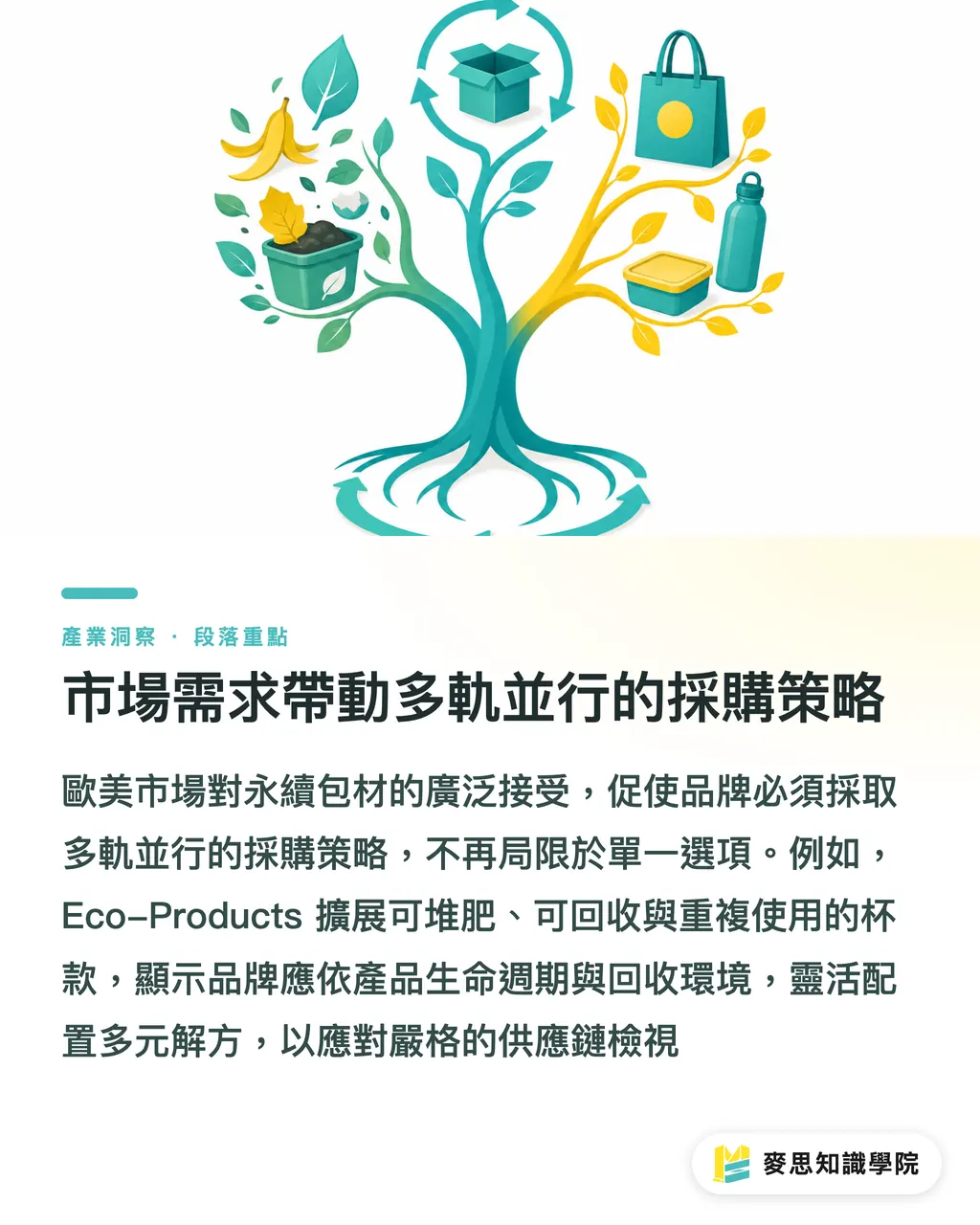
Market Demand Drives Multi-Track Procurement Strategies
The acceptance of sustainable packaging in European and American markets has been fully unlocked; it is no longer a multiple-choice question where only one material can be selected
Taking the product lines recently expanded by Eco-Products as an example, they are simultaneously promoting compostable, recyclable, and reusable cup categories
This tells us that brands should flexibly configure solutions based on the product life cycle and terminal recycling environment when planning packaging
Mastering these parallel technological routes is the only way to hold substantial use when facing rigorous supply chain audits
Key Takeaways
・EU PPWR regulations will mandate compostability for specific packaging by 2030, making compliance standards a hard barrier for exports
・TIPA and other major manufacturers have broken through film technology bottlenecks, and compostable packaging is officially capable of mass production and production line integration
・Print shops must conduct early testing on ink adhesion and non-plastic lamination processes to avoid processing steps that invalidate compostability certifications
・Brands can adopt a multi-track strategy, or prioritize the introduction of compostable materials for high-contact components such as labels and caps
Extended Reflections
Looking at the mainstreaming trend of compostable packaging, the future printing supply chain will definitely be a dual competition of 'material science' and 'regulatory interpretation capability'
For small and medium-sized print shops in Taiwan, this is an excellent opportunity to escape the red ocean price war
Do not wait for clients to come to you with EN 13432 specifications asking if you can print them; you should proactively propose pre-tested compostable ink solutions
Combine this with a one-stop service platform like MINDS to plan the entire package from source design and material selection to post-press processing
When you can help clients solve their anxiety about compliance for exporting to Europe and the US, what you are selling is not just print materials, but a ticket to the international market
Further Reading
FAQ
- What specific impact does the EU PPWR regulation have on packaging exports from Taiwan?
- Specific packaging must be compostable by 2030. If certifications such as EN 13432 cannot be produced, products will face the risk of being unable to enter the European market
- Why not just use traditional recycled plastic?
- Regulations are shifting from passive recycling to mandatory design scrutiny at the source. For some flexible packaging or containers that are easily contaminated with food residues, using compostable materials makes it easier to meet the standards
- What technical bottlenecks are most frequently encountered when introducing compostable packaging to production lines?
- The most common issues are poor ink adhesion and heat seal failure. Additionally, traditional lamination processes will cause the entire package to lose its compostability status, requiring alternative processes
- How can brands with limited budgets begin the process of de-plasticizing their packaging?
- There is no need to switch all materials at once. Starting with high-contact small components such as compostable labels or fiber lids is currently the path to compliance with the highest return on investment and the fastest turnaround
References
Related articles

The Print × AI weekly
The print and AI know-how designers, brands and enterprises can use before they commit — one email, every week
MINDS Free Tools
Spine width and imposition calculators — skip the manual math, free in your browser.
MINDS Group
Need actual printing or gifting services?
From premium printing to online ordering and festive gifts — the MINDS Group sister brands take it from here.