
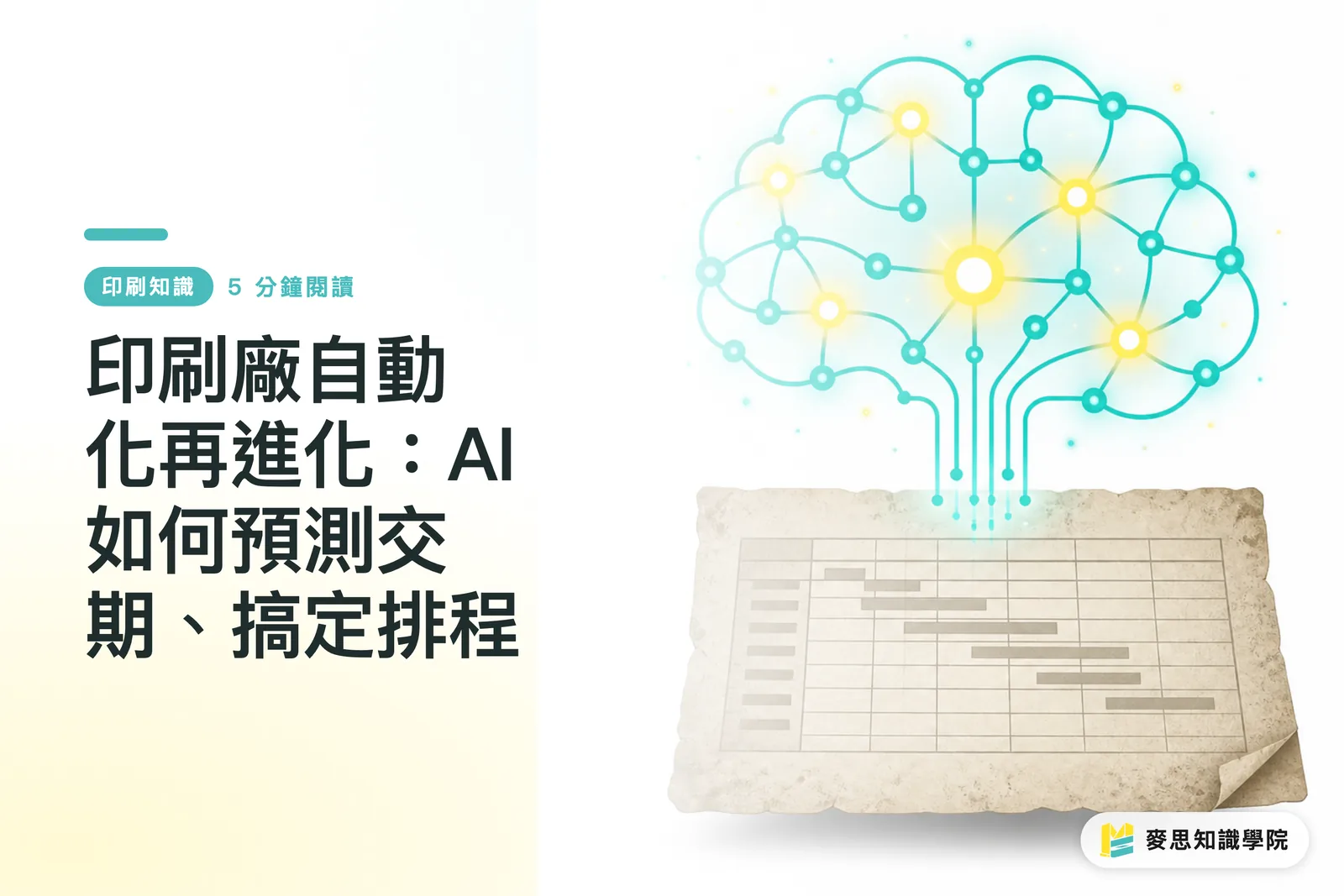
AI image generation is flashy, but have you spotted the real bottleneck in printing plants?
In the last six months, eight out of ten clients I've encountered are experimenting with AI image generation. They come to me with designs generated by Midjourney or Stable Diffusion, excitedly asking how they can be printed to look as stunning as they do on screen. Of course, I'm delighted to see new technology inject fresh energy into design
But honestly, based on my experience handling thousands of print projects, design is just the first mile. The real 'boss level' challenge only begins after the file enters the factory
The operational heart of a printing plant has never been the fastest printing press; it's the production scheduling system that decides 'who comes first, which machine to use, and when it will be ready.' In the past, this mostly relied on the experience of master craftsmen and Excel spreadsheets. However, facing a market with small-batch, high-variety orders and increasingly urgent delivery deadlines, human brains and spreadsheets quickly reach their limits. This is the biggest pain point in the entire industry
How exactly does AI-powered intelligent scheduling work?
So-called AI-driven intelligent scheduling is essentially hiring a super-brain to act as the factory's chief dispatcher. Unlike a human, it doesn't get tired, forget things, or have personal biases; it only looks at the data to make the most efficient decisions
The entire process generally works like this:
・Automated Order Analysis: When a new order comes in, the system automatically decomposes the key information: item, quantity, size, paper stock, post-processing (UV coating, cutting, binding), etc
・Complete Resource Inventory: At the same time, the AI scans the real-time status of the entire plant, including the load on each printing press, which operator is on shift, current inventory levels of paper and ink, and even factors in the scheduled maintenance time for the machinery
・Dynamic Scheduling Optimization: Then, it compares millions of possible production paths based on the order's characteristics and delivery requirements. For example, in a case I recently saw, for an urgent order of 5,000 A5 flyers, the AI discovered that although the most suitable 'Machine A' was running another job, the overall completion time would be faster if it waited 20 minutes rather than immediately using 'Machine B,' which was idle but 10% less efficient. It would decisively choose to wait, a type of decision-making that is easy to overlook during high-speed human cognitive processing
・Real-time Monitoring and Alerting: Once the schedule is set, it's just the beginning. The AI continuously monitors the production line. If it detects any anomalies, such as a machine slowing down or running out of paper, it immediately issues an alert and even automatically adjusts subsequent scheduling to minimize the impact
The core of this entire operation is taking tacit knowledge, previously dispersed across different departments or even stored only in the minds of master craftsmen, and making it all data-driven and transparent, ensuring decisions are evidence-based
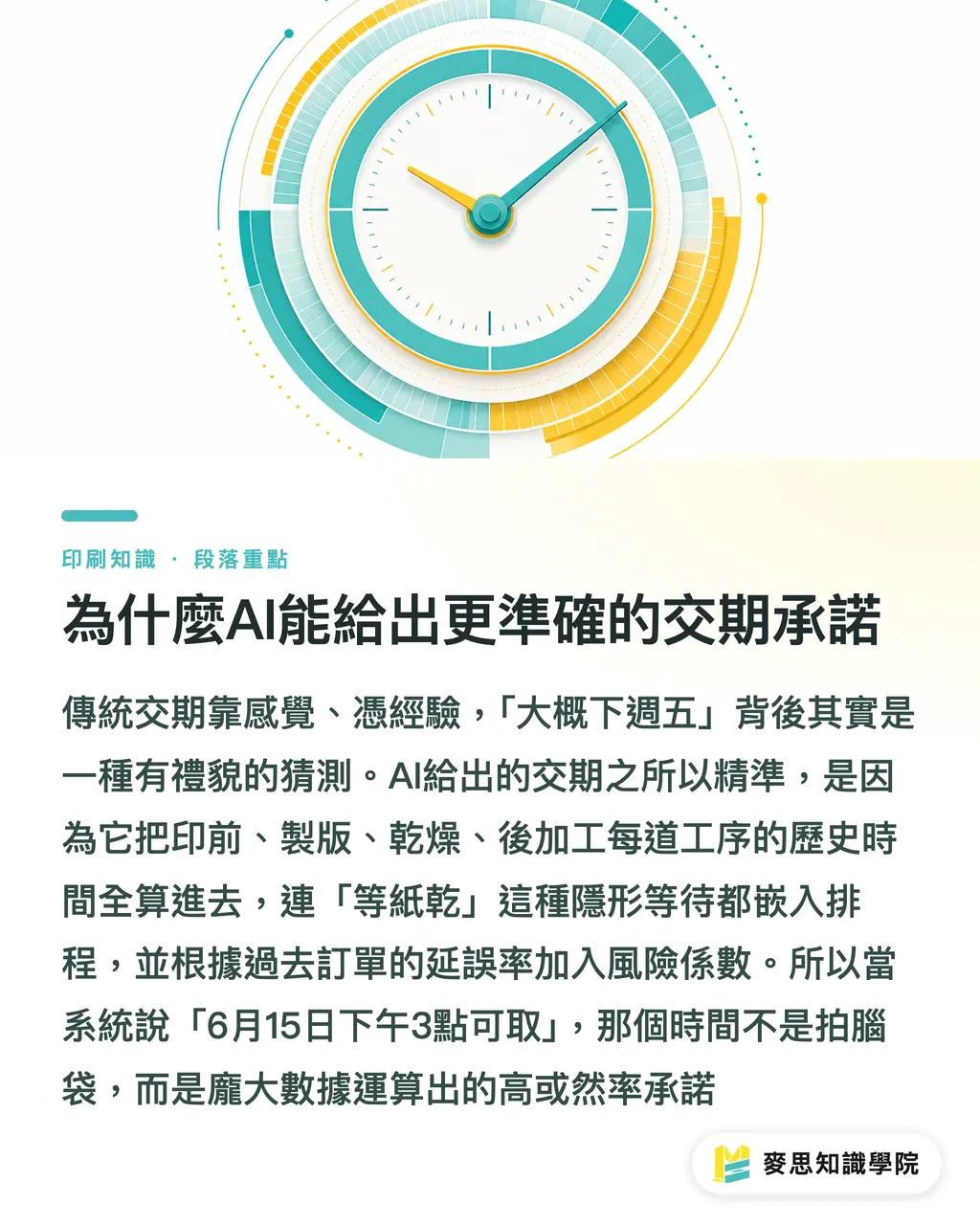
Why can AI offer more accurate delivery time commitments?
"Boss, when will this order be ready?" This is probably the question all printing sales reps fear most. Past answers were usually "about three days" or "sometime next Friday." These vague answers stem from the extreme uncertainty in the production process
The reason AI can provide more precise delivery dates isn't because it can predict the future, but because it looks at the picture from broader and more detailed perspectives
・It counts more than just printing time: Traditional time estimation only looks at the rotation speed of the printing press. However, AI accounts for the entire workflow, including pre-press file inspection, CTP plate making, ink drying, UV coating, cutting, folding/gluing, binding, and packaging. The time for each step is accurately estimated based on historical data
・It understands the "cost of waiting": Often, what slows down progress isn't the "doing," but the "waiting"—waiting for paper to dry, waiting for materials, waiting for the previous step to complete. AI perfectly inserts these necessary waiting times into the gaps of the production schedule like building blocks, maximizing time use
・It learns lessons from history: AI analyzes data from all past orders. It knows that for a specific type of paper paired with a specific ink, the drying time might require an extra 2 hours. It also knows that for a certain complex post-processing step, the average delay rate in the past was 15%. It translates these "experiences" into risk coefficients and adds them to this order's delivery prediction
Therefore, when the AI tells you, "You can pick it up on June 15th at 3 PM," this time is the result of a high-probability outcome derived from massive data and complex calculations, rather than a rough estimate based on a feeling
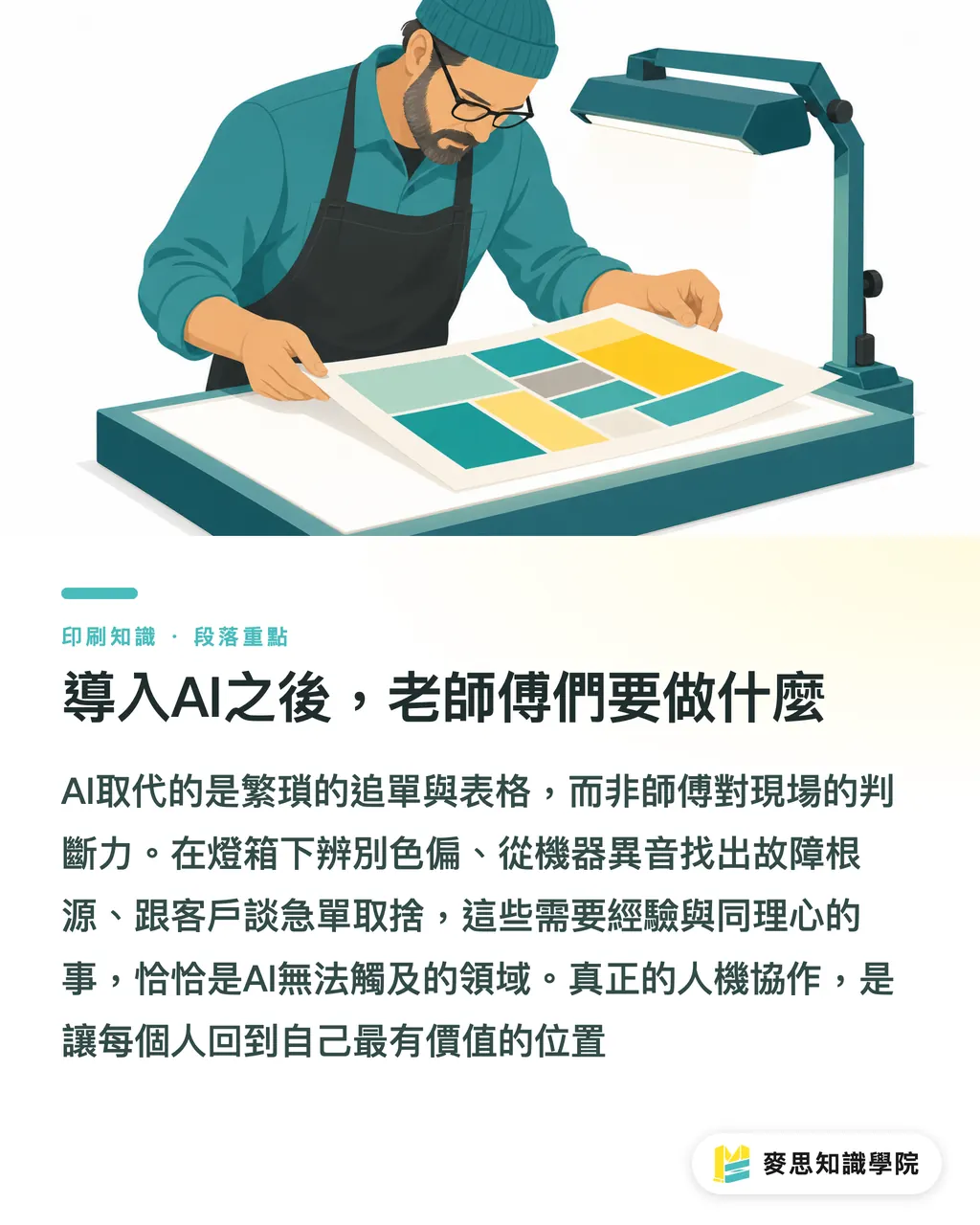
What will the master craftsmen do after introducing AI?
Many people worry: if machines are this capable, what will humans do? Will we be replaced? My observation is that not only will this not happen, but human value will actually become more highlighted
AI excels at handling repetitive tasks with clear rules, but the printing floor is full of various "exceptions."
・Quality Gatekeeping: AI can check the resolution of a file, but it can't tell if the design's colors go well together, nor can it judge under a light box whether color shifts are coming from the ink or the paper, as the human eye can
・Anomaly Handling: If a machine breaks down, the AI triggers an alarm, but finding the root cause and performing emergency repairs still relies on experienced master craftsmen. They can even "listen for cues" and identify the source of a problem from the machine's unusual noise
・Complex Communication: Communicating the trade-offs of an urgent order with a client, or explaining to a designer why a certain effect cannot be printed, these interactions require empathy and professional judgment, which AI cannot replace
In short, AI liberates people from tedious Excel spreadsheets and phone calls, allowing production managers to focus on walking the production line and solving emergencies; it allows sales reps to spend more time serving clients rather than spending all day asking about internal progress. This is true human-machine collaboration, letting everyone do what they are best at and what is most valuable
Key Takeaways
・The core of AI scheduling is integrating real-time data on orders, machines, materials, and labor to make global optimal decisions
・Precise delivery prediction comes from AI's analysis of historical data rather than simple addition of labor hours. It accounts for hidden times such as drying and post-processing
・Introducing AI is not meant to replace labor, but to release labor from repetitive scheduling work into higher-value quality management and anomaly handling
・For designers and end customers, intelligent scheduling means more reliable delivery commitments and faster feedback on order status
Further Reflections
・For printing industry peers: Don't think about getting everything done at once. Start with the most painful point. For example, first implement the structuring of order data, or conduct production monitoring for specific machines. Data is the foundation of all this; only with clean data can AI help
・For designers: In the future, the more standard and cleaner your files are, the more painlessly they will enter the automated process, allowing you to enjoy the fastest production speeds. Conversely, files that don't meet specifications may be held up or downgraded by the system. File standardization is a new skill set that designers need to acquire
・For AI and SaaS providers: The printing industry runs deep. Having an algorithm alone isn't enough. The point is how to translate complex scheduling logic into an interface that production line staff can understand and are willing to use. UI/UX is the key to creating differentiation. Don't think about selling a massive, all-encompassing system; tools that can solve one small, precise pain point are more likely to break into the market
FAQ
- Is it expensive to implement an AI scheduling system?
- Initial implementation is indeed an investment, but the ROI comes from reduced waste, improved machine use, and customer trust won through more punctual delivery. Long-term, it can effectively reduce overall operating costs. There are now also many SaaS subscription services, significantly lowering the barrier to entry
- Is this type of intelligent scheduling system suitable for small printing plants?
- Very suitable. It could even be said to be an opportunity for small printing plants to overtake the competition. Large factories have complex processes, and introducing AI can be a heavy burden. Small plants are more agile and can start from the most painful point, for example, by first solving the automation of order taking and estimating, which can release a large amount of human resources
- Is the delivery time predicted by AI really 100% accurate?
- No system can guarantee 100% because unexpected events always happen, such as temporary large-scale power outages. However, the accuracy of AI-predicted delivery times is far higher than human estimation because it incorporates more variables and is more objective. It can learn continuously, making predictions increasingly close to reality
Related articles
The Print × AI weekly
The print and AI know-how designers, brands and enterprises can use before they commit — one email, every week
MINDS Free Tools
AI background removal, brand stamping, and a LINE sticker maker — free design tools, right in your browser, no upload.
MINDS Group
Need actual printing or gifting services?
From premium printing to online ordering and festive gifts — the MINDS Group sister brands take it from here.