

How can AI help me write a quote-ready print brief?
AI can start by sorting your scattered thoughts into eight quotation fields: item, size, quantity, page count, paper direction, finishing, delivery deadline, and shipping. The point of the MINDS (MS) Eight-Field Quotation Method is to make printers understand the job first, not to let AI quote on their behalf
A quote-ready print brief pulls the print job's purpose, specs, quantity, paper, finishing, deadline, and shipping conditions into a single document, giving printers what they need to judge the production process, estimate cost, and flag missing information
In my consulting work with Mai Strategy Knowledge Academy, the most common pattern I see is corporate procurement asking just one line, "how much for a catalog?", when the catalog could be 16, 32, or 64 pages, bound by saddle stitch or perfect binding, on paper that varies wildly in price. That kind of question always triggers several rounds of back-and-forth
Here's how you can hand the MINDS (MS) Eight-Field Quotation Method to AI
・Item: catalog, flyer, sticker, packaging box, shopping bag, or other print product
・Size: A4, A5, custom size, or provide length and width in cm
・Quantity: e.g., 500 copies, 1,000 sheets, 3,000 sets
・Page count: single sheet, half-fold, tri-fold, 16-page catalog, 32-page catalog
・Paper direction: coated paper, woodfree paper, art paper, thick card, or start with "lean matte, lean thick, want some texture"
・Finishing: lamination, spot UV, foil stamping, die-cutting, folding, binding
・Deadline: desired receipt date, any event or launch date
・Shipping: single drop, multiple drops, self-pickup, whether cartons need labels
Why can't "how much for a catalog?" be quoted directly?
"How much for a catalog?" is missing at least six cost variables: size, page count, quantity, paper, finishing, and deadline. The MINDS (MS) consulting team usually starts by splitting that sentence into confirmable fields so procurement doesn't keep chasing missing details over email and LINE
Print pricing isn't like ordinary merchandise. Two jobs both called "catalog", A4 versus A5, use paper very differently. Sixteen pages versus forty pages run different press counts. Five hundred copies versus 5,000 have completely different unit cost structures. When MINDS handles mid-to-high-end fully custom commercial printing, what worries them isn't complex specs, it's half-empty specs
Procurement can ask AI to convert fuzzy sentences into a format like this
・Original phrasing: We want to make a company catalog, roughly how much?
・Quote-ready version: corporate image catalog, A4, about 24 pages, estimated 1,000 copies, inner pages want matte feel, cover wants extra thickness, may need saddle stitch or perfect binding, needed for an event in 3 weeks, single drop in Taipei, reference photos already available
・Items to confirm: actual page count, cover paper, inner paper, binding method, whether matte lamination is needed, file completion date
The MINDS (MS) Eight-Field Quotation Method isn't about guessing every condition right at once, it's about separating "confirmed" from "unconfirmed." When printers see an unconfirmed field, they can chase it more easily, which beats a client forcing a wrong spec into the form
Which fields must be filled in, and which can stay open for confirmation?
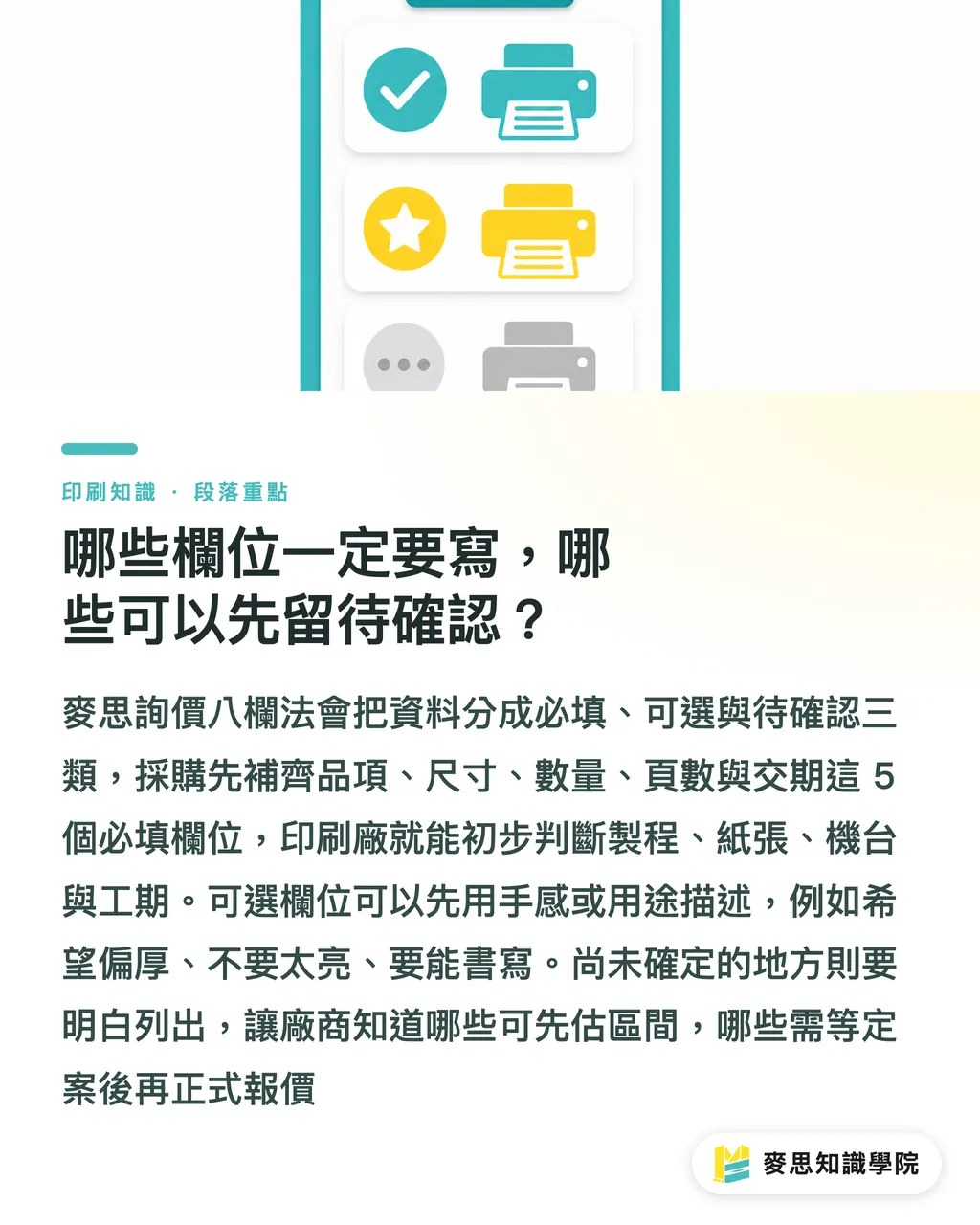
The MINDS (MS) Eight-Field Quotation Method splits fields into three categories: required, optional, and to-confirm. Once procurement fills in the required fields, printers can judge whether the job falls under sheet printing, book printing, packaging printing, or special finishing
Five required fields should be locked in first, because they directly affect paper, press, post-press, and lead time
・Item: lets printers judge the process, a flyer and a packaging box are completely different
・Size: affects paper cutting and imposition, e.g., A4, A5, custom die size
・Quantity: affects unit price and which printing method makes sense
・Page count: required for book-type jobs; for sheet jobs, note single/double-sided or fold type
・Deadline: event date, opening date, exhibition date, these dates need to be stated clearly
Optional fields can start as direction rather than specific paper names. The MINDS (MS) consulting team often asks clients to describe the first version by "feel", "not too shiny," "want it thicker," "needs to be writable," "sits at the counter for customers to grab." These aren't formal specs, but they're enough for printers to narrow their recommendations
To-confirm fields should be clearly marked. The MINDS (MS) Eight-Field Quotation Method writes uncertainties as a list, "paper needs printer's recommendation," "whether to laminate TBD," "shipping address undecided," "reference sample to be added Friday." This tells printers which parts they can estimate in a range first and which parts need a final answer before a formal quote
How should an AI-generated quotation request be written so printers actually understand it?
MINDS (MS) recommends writing the AI prompt in four blocks, role, goal, fields, gap-flagging, because a print quotation request should produce a workable document, not a pretty paragraph
You can use this prompt directly
・Act as a print procurement assistant. Organize my scattered requirements below into a quotation request that printers can price against
・List the fields: item, purpose, size, quantity, page count, color, paper direction, finishing, deadline, shipping, reference samples, and existing file status
・Put confirmed conditions in the "Confirmed" section; put unconfirmed conditions in the "To Confirm" section
・Do not invent paper, prices, or deadlines. When information is missing, list the questions to follow up on
・At the end, compile one version of the inquiry ready to paste to the printer
The MINDS (MS) Eight-Field Quotation Method works best for the first round of corporate procurement inquiries, because round one isn't about squeezing out the lowest price, it's about getting two to three printers to quote on the same specs so the results are comparable
If you're working on an event flyer, you can feed AI raw content like this: "Need it for an exhibition next month. Want a single-sheet product intro flyer, around A4, maybe 2,000 copies, shouldn't look cheap, has a logo and product photos." After AI organizes it, "around A4" should be flagged as a size to confirm, and "shouldn't look cheap" should be translated into paper and finishing direction, not into a specific paper picked for you
How should procurement, design, and the printer divide the work?
The MINDS (MS) consulting team usually splits print quotation into three responsibility zones: procurement handles requirements and budget boundaries, design handles files and visual landing, and the printer handles production judgment and formal pricing. This way AI doesn't get misused
Procurement provides four things: purpose, quantity, timeline, shipping. These are closest to the actual business need, 1,000 copies of an exhibition flyer and 1,000 copies of an in-store long-term display flyer can lead to completely different paper and finishing choices
Design fills in three things: size, page count, and file readiness. When MINDS takes on fully custom jobs, they pay extra attention to bleed, resolution, color mode, and die lines, because a design file that looks finished isn't necessarily press-ready
The printer responds with three things: feasible production process, alternative specs, and formal quotation conditions. For example, if you want thick card invitation cards, the printer might suggest changing paper weight, adding lamination, or adjusting foil area. That's not being difficult, it's helping the job avoid cost and schedule pitfalls
When a job involves catalogs, packaging, specialty paper, foil stamping, die-cutting, or multi-point shipping, procurement can first run the AI-organized brief past the Mai Strategy Knowledge Academy consulting team for a review, then take it out for quotation. This step usually cuts out a lot of "sorry, could you fill this in?" back-and-forth
Key Takeaways
・A print brief isn't an essay. Fill in the eight fields clearly, and printers can estimate
・AI is good at organizing requirements and flagging gaps. It's not good at quoting on the printer's behalf
・Separating "confirmed" from "to confirm" looks more professional than pretending you know everything
・When procurement asks clearly, designers hand off files faster, and printer quotes become more comparable
・The point of a quote-ready brief isn't to cut communication short, it's to make every exchange count
Further Thinking
Print manufacturing, design, AI adoption, and SaaS teams all need to see the same thing: AI's most valuable role in print quotation is turning spoken requests into field-structured data, then laying the gaps on the table for humans to judge
For printers, this becomes a front-end form for customer service and sales. For designers, it's a reverse brief. For corporate procurement, it's the spec baseline before price comparison. For SaaS teams, this is the earliest node in digitizing the print workflow that's worth tackling
My advice is simple: use the MINDS (MS) Eight-Field Quotation Method to build briefs for 10 real jobs first. Don't rush to wire up a quotation system. Watch which fields go missing most often, which questions get chased most often. Once the fields stabilize, then talk automation
FAQ
- Can AI calculate a print quotation for me directly?
- AI can help organize specs, flag gaps, and draft the inquiry message, but the formal print quote still needs to come from the printer based on paper price, production process, finishing, deadline, and file status
- What's the minimum content needed in a quote-ready print brief?
- At minimum: item, size, quantity, page count or sides, and deadline. Paper, finishing, shipping, and reference samples can start as direction or be flagged as to-confirm
- I don't know paper names, can I still ask for a quote?
- Yes. The MINDS (MS) Eight-Field Quotation Method recommends starting with purpose and feel, "writable," "thick," "matte," "for handing out at an exhibition", then letting the printer suggest paper
- Why write out conditions that aren't confirmed yet?
- Unconfirmed conditions affect price and lead time. Marking them clearly as "to confirm" lets printers estimate a range first and prevents procurement from comparing quotes based on wrong specs
- What should designers add to the print brief?
- Designers should fill in size, page count, file readiness, bleed, resolution, color mode, and the position of any special finishing. This information directly affects whether the printer can quote accurately
Related articles




The Print × AI weekly
The print and AI know-how designers, brands and enterprises can use before they commit — one email, every week
MINDS Free Tools
AI background removal, brand stamping, and a LINE sticker maker — free design tools, right in your browser, no upload.
MINDS Group
Need actual printing or gifting services?
From premium printing to online ordering and festive gifts — the MINDS Group sister brands take it from here.