
Why are customer print requests always so abstract?
In my experience handling thousands of printing projects, most clients' understanding of printing is limited to what they can see and feel
They might say, 'I need a batch of flyers; make the paper a bit thicker and give it a premium feel,' but for a printing plant, this statement contains zero actionable information
A work order that allows a factory to run efficiently and provide an accurate quote must contain explicit physical parameters
If sales or procurement teams don't pin down these specs at the start, the subsequent back-and-forth confirmation consumes significant hidden costs
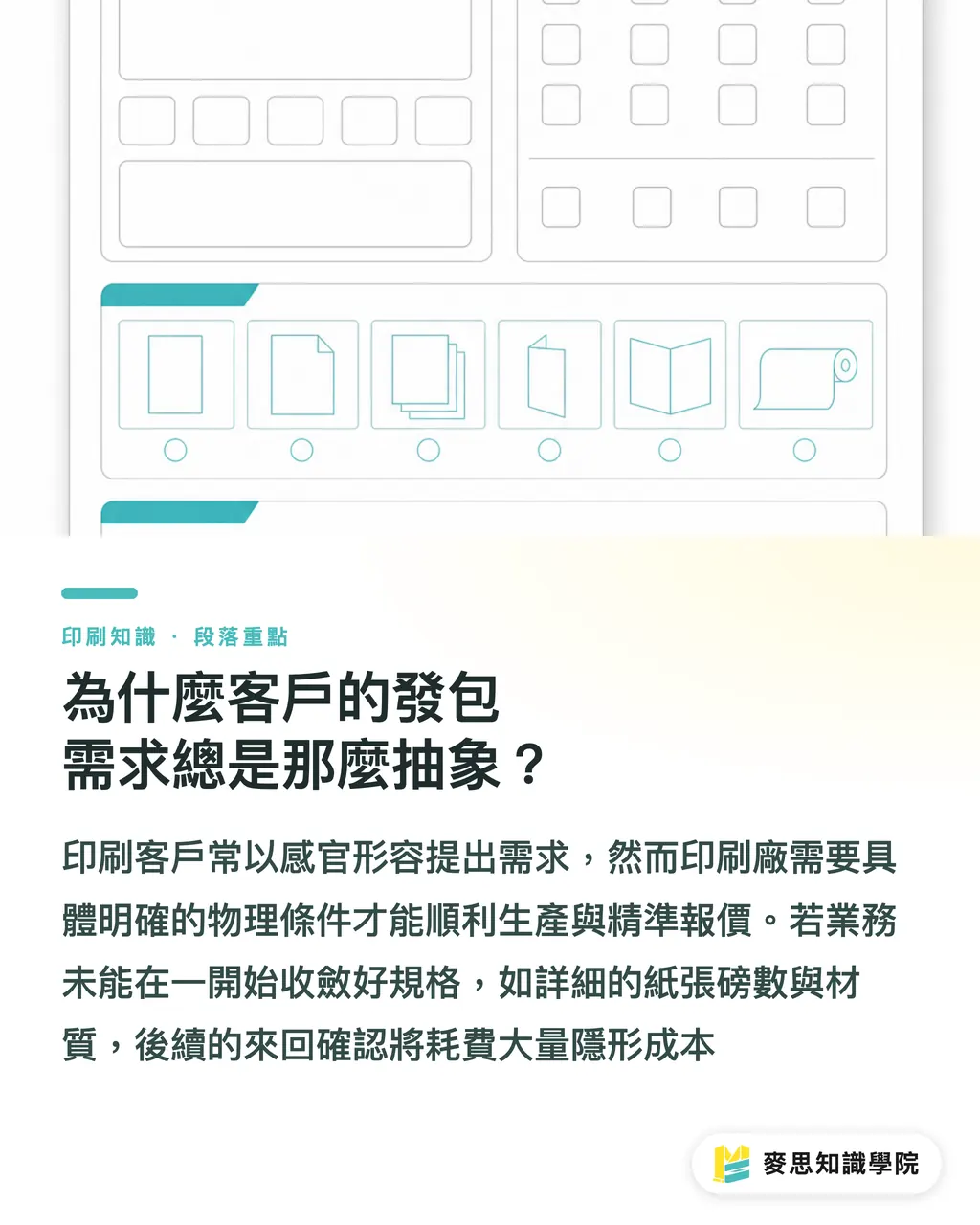
In practice, the key variables that truly affect unit price and production processes include the following:
・Finished size and bleed settings
・Paper weight and material (e.g., 250g coated cardstock or 300g ivory board)
・Total order quantity and split-delivery requirements
・Post-printing finishing details (e.g., spot UV, hot stamping, embossing)
・Deadline and packing methods (e.g., kraft paper wrap or cardboard boxes)
How can AI act as a competent print spec interviewer?
Recently, many peers have rushed to connect AI to LINE, hoping to replace customer service agents, only to frequently ruin the customer experience
This happens because most people just let the system chat aimlessly without giving it a clear task of 'narrowing down specifications.'
In fact, simply by changing the approach and positioning the conversation model as a 'Specification Interviewer,' it can provide immense value as a gatekeeper
We can design a specialized prompt for print requirement inquiries
When a client throws out a vague pricing request, the AI will automatically cross-reference the required specification list in the background
If it detects missing information, it won't rush to give an answer; instead, it will ask the customer questions logically one by one
For example, it might ask, 'Would you prefer the premium feel to be achieved through hot stamping or spot UV?'
This method guides the client to think, condensing trivial conversations that would normally take an assistant half a day to confirm into just a few minutes
Practical breakdown: How to write precise inquiry prompts?
For a language model to understand and execute tasks accurately, the prompt must have three layers: role definition, a checklist, and an output format
I recommend defining the role at the very beginning of the instruction: 'You are a senior print sales assistant responsible for converting customer's colloquial requests into a standard specification sheet.'
Next, include the required fields that the factory usually needs for quotes, and require the AI to use a one-question-at-a-time format, don't overwhelm the client by asking ten questions at once
Once all conditions are confirmed, the prompt must require the output of a structured text list
The format can be set up like this:
・Project Name: Spring Brand Flyer
・Size: A4 (210x297mm)
・Material: 150g Premium Coated Paper
・Finishing: Double-sided Matte Lamination
・Quantity: 2,000 sheets
Once this list is produced, the procurement team can copy and paste it directly to the printing partner to immediately enter the actual quoting phase
What practical pain points can automated interviewing solve?
Applying this technology to requirement translation addresses the fundamental issue of information asymmetry in the industry
For freelance designers or corporate procurement officers, the biggest fear is missing one or two specs, leading to incorrect cost calculations or errors that require reprinting
Through a mandatory verification mechanism, every inquiry submitted will be a complete specification including thickness, size, and finishing details
I have observed that this workflow can shorten the communication period, which usually takes three days on average, down to a single afternoon
It also reduces the risk of novice buyers forgetting to confirm delivery conditions due to a lack of experience
This not only saves time for both parties but also allows the printing plant to quickly grasp the full picture and provide the most accurate quote evaluation
Key Takeaways
・'Feelings' cannot be quoted; they must be converted into physical parameters like size, material, quantity, and post-printing finishes
・Don't let the machine chat aimlessly; give it a clear checklist to serve as the boundaries of the conversation
・Prompts must include role settings and a one-question-at-a-time mechanism, finally outputting a standardized list
・Using tools to narrow down requirements can compress a three-day communication period for new projects down to half a day
Further Reflection
The digital transformation of the printing and manufacturing industry often starts at the very beginning of communication. For teams like MINDS Printing that provide one-stop integrated services, translating a client's vague imagination into precise manufacturing specifications at an extremely low cost not only saves the factory time, but is also a concrete demonstration of professional consultant value
Further Reading
・AI turns vague client requests into print specs? A practical Q&A guide for procurement
FAQ
- What if the client has no concept of size at all?
- You can add common references to the prompt, letting the AI provide examples like 'Do you need it as large as A4 printer paper, or as small as a postcard?' to guide their selection
- Can the organized spec sheet be used directly as a formal contract?
- No, this list is meant to accelerate the preliminary inquiry and quoting process. The final formal quote must still be issued by the printing plant after confirming machine scheduling and actual costs
- Is this method applicable to all types of printed matter?
- It is best suited for products with a higher degree of standardization, such as flyers, posters, and business cards. For products involving complex structures or combined materials, senior sales personnel still need to intervene for personal evaluation
Related articles

The Print × AI weekly
The print and AI know-how designers, brands and enterprises can use before they commit — one email, every week
MINDS Free Tools
AI background removal, brand stamping, and a LINE sticker maker — free design tools, right in your browser, no upload.
MINDS Group
Need actual printing or gifting services?
From premium printing to online ordering and festive gifts — the MINDS Group sister brands take it from here.