
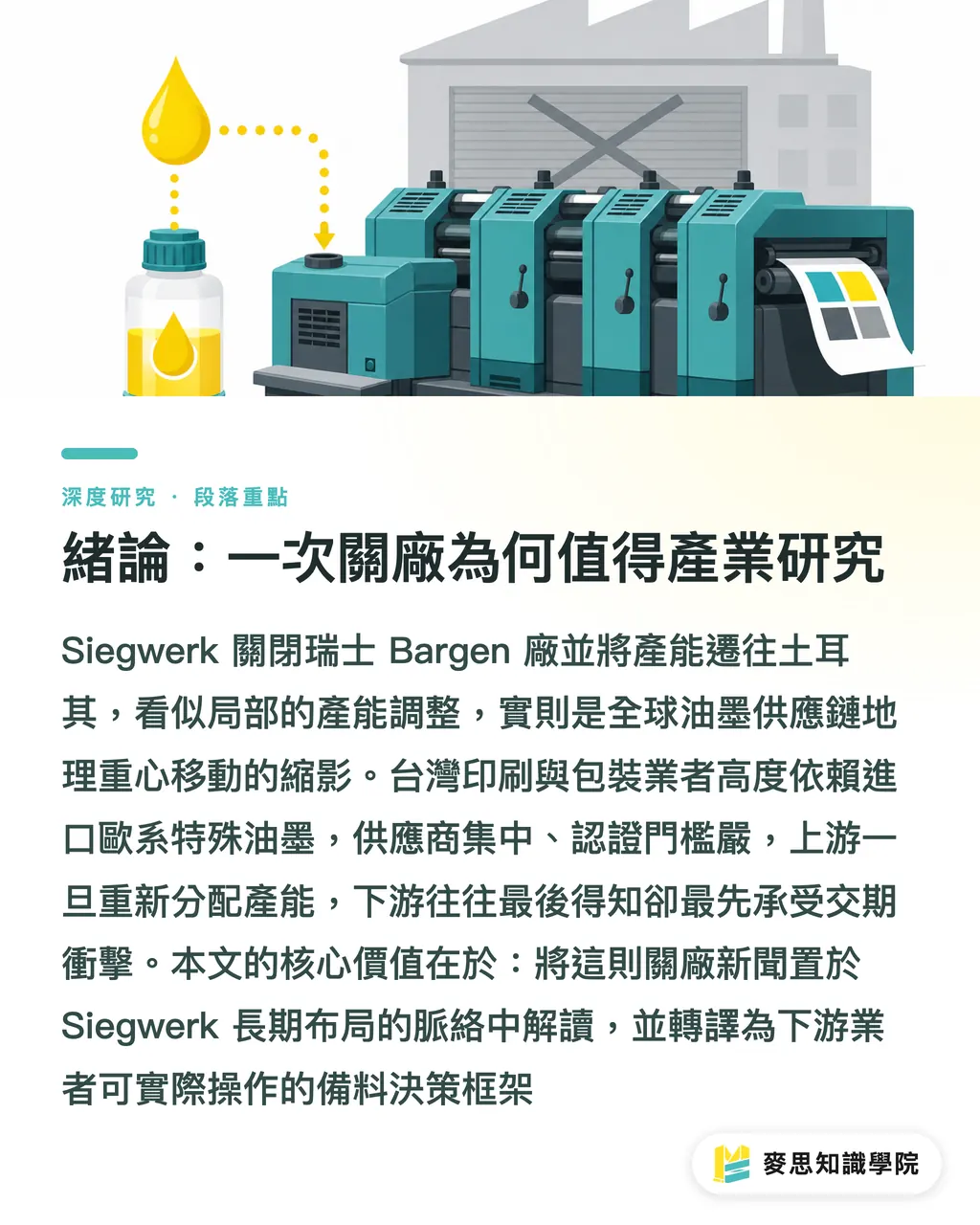
Introduction: Why a Single Plant Closure Warrants Industry Analysis
Ink is a critical input in the printing process with low value proportion but extremely low substitution elasticity. When Siegwerk, a globally leading printing ink manufacturer, announced the closure of its Swiss Bargen production facility and concentration of capacity at Tuzla, Turkey, this seemingly localized capacity adjustment actually touches on a more fundamental question: the geographic center of the global ink supply chain is shifting, and downstream printing operators' risk awareness may not be sufficient [1]
This article seeks to answer three core questions:
・First, where does this plant closure sit in Siegwerk's own global layout evolution—is it a contingent decision or a continuation of long-term trends?
・Second, how do structural pressures on European ink manufacturing transmit to downstream procurement through capacity reallocation?
・Third, for Taiwan's printing and packaging industry, which primarily imports specialty inks from Europe (such as food-safe grades and solvent-free UV systems), what are the actual implications for lead times, pricing, and quality consistency, and what actionable response strategies exist?
This topic carries real industry significance for Taiwan. Taiwan's printing and flexible packaging sector relies heavily on imported specialty inks for high-end applications, and these inks typically have high supplier concentration, strict certification barriers, and large switching costs. When upstream capacity is reallocated, downstream players are often the last to know but the first to bear delivery volatility. This article's contribution lies in contextualizing a single industry news item within that enterprise's long-term documentary record and translating macro supply chain shifts into actionable inventory decision frameworks for downstream actors
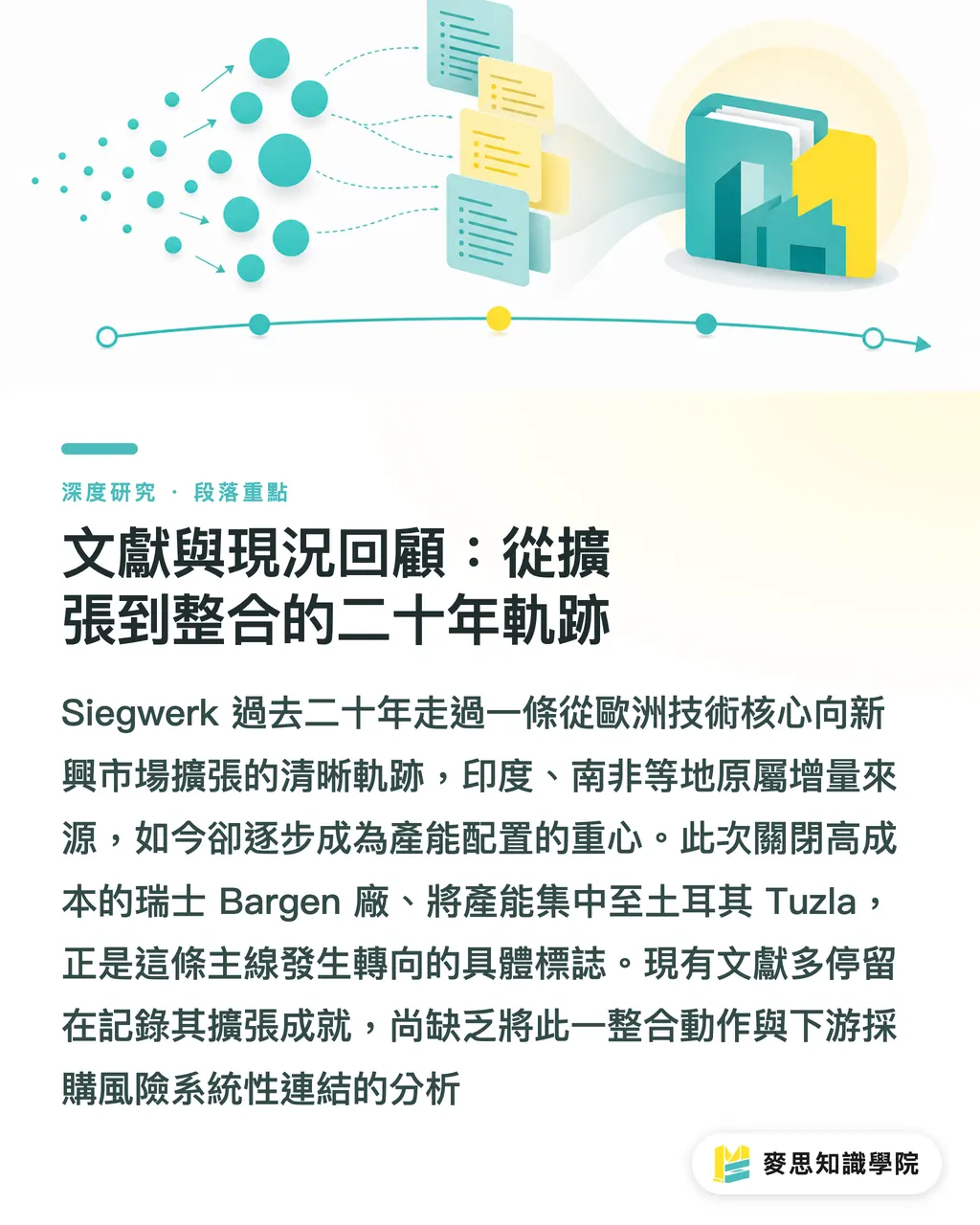
Literature Review and Current Context: Two Decades from Expansion to Consolidation
This section first reviews Siegwerk's publicly documented development over the past two decades, then narrows to the gap this plant closure reveals—one that existing discussions have not fully addressed
From existing literature, Siegwerk during the first decade of the twenty-first century presents a clear trajectory of global expansion. In 2004, the group acquired Color Converting Industries, strengthening its portfolio in specific ink segments and regional markets [6]. Around 2008, activity intensified: the group gained significant footholds in India, entering rapidly growing emerging markets [2]; concurrently, its CEO Herbert Forker was elected chair of the European Printing Ink Association (EuPIA), indicating the enterprise's weight in Europe's industry governance structure [3]. On the technology front, the group launched volume production of waterless web offset ink in 2008, reflecting investment in process innovation [4]. In 2009, operations in South Africa also appeared in reports, continuing its penetration narrative in African and emerging regions [5]
Grouping these fragments by topic reveals two parallel main lines. The first is geographic market expansion: India [2], South Africa [5], and other emerging markets were clear growth targets at that time. The second is the accumulation of technology and industry standing: volume production of waterless web offset [4] and EuPIA leadership [3] jointly underpinned its technical legitimacy in Europe's core markets. Notably, these two lines did not conflict at that time; Europe was the center of technology and governance, while emerging markets were the source of incremental growth
However, this plant closure reveals tension between these two lines. According to first-hand reporting, Siegwerk's rationale for closing the Swiss Bargen facility included: high production costs in Switzerland, the erosion of competitiveness from the strong Swiss franc, and declining demand in some printing ink markets [1]. The group concentrated production at Tuzla and explicitly noted that its primary growth momentum comes from Eastern Europe, the Middle East, and Africa, and that Tuzla is positioned to most cost-effectively serve these markets [1]. In other words, emerging markets that once served as "sources of incremental growth" [2][5] are now gradually becoming the "center" of capacity allocation, while high-cost European facilities shift from core status to being eliminated
The gap in existing public discussion lies precisely here. Existing literature largely documents Siegwerk's expansion and technology achievements [2][3][4][5][6], yet few analyses connect recent consolidation moves to downstream procurement risks. This article's analysis argues that the plant closure news itself provides only the upstream decision result, without explaining the supply implications for specific downstream regions (such as Taiwan); this is precisely the analytical space this article attempts to fill
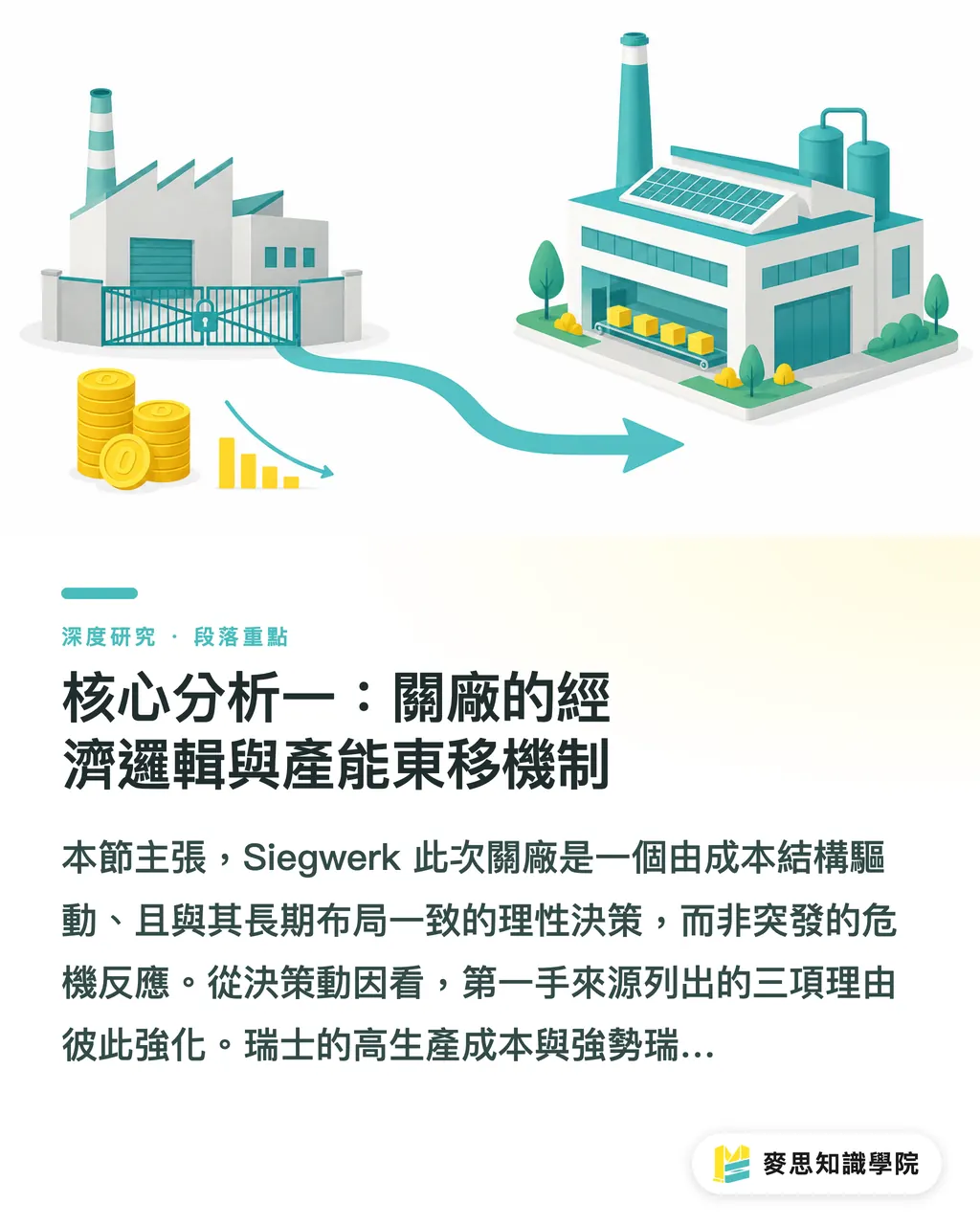
Core Analysis One: The Economic Logic of Plant Closure and the Mechanism of Eastward Capacity Shift
This section argues that Siegwerk's plant closure is a rational decision driven by cost structure considerations and consistent with its long-term positioning, rather than a sudden crisis response
From the perspective of decision drivers, the three reasons cited by first-hand sources mutually reinforce each other. Switzerland's high production costs and the strong Swiss franc represent two sides of the same structural problem: production costs denominated in Swiss francs are further amplified by exchange rates in export-oriented competition, causing the Swiss facility's cost ranking within the group to continuously worsen [1]. The third reason—declining demand in some ink markets [1]—aligns with broader trends: in certain traditional print segments, structural demand has not recovered to previous levels, and excess capacity encourages enterprises to pare back high-cost facilities
From the perspective of capacity takeover, Tuzla was not a temporary choice. Reports indicate that the Tuzla facility underwent major modernization in 2020 that increased capacity by 20% and added 20 jobs, bringing total headcount to 130 people [1]. This article's analysis suggests that this investment, made several years before the closure announcement, indicates that eastward capacity migration is a long-term path laid out well in advance, not a hasty cost escape; expanding the receiving end first, then cutting the high-cost end, is a typical capacity reallocation sequence
From a geographic strategy perspective, the group explicitly states its growth focus is Eastern Europe, the Middle East, and Africa, and Tuzla is located near Istanbul, positioned right at the nexus of these three regions [1]. Reading this alongside the expansion trajectory from twenty years ago reveals a coherent logic: the penetration of emerging markets such as India [2] and South Africa [5] back then, and today's anchoring of production at Turkey to serve the EEMEA region, belong to different stages of the same long-term strategy of "aligning gravity with growth markets."
It is worth emphasizing the limits. This closure affects over one hundred positions, and the group has negotiated severance arrangements for affected employees while retaining its technical operations in Switzerland [1]. Retaining technical functions while only transferring production shows the group's adjustment as a selective convergence of "production de-Europeanization, R&D staying in Europe," rather than a complete withdrawal. This article's analysis argues that this model has dual implications for downstream: continuity of technical support may be preserved, but the geography and logistics route of physical supply have changed
Core Analysis Two: From Upstream Shift to Downstream Lead Time Transmission
This section argues that upstream geographic repositioning of capacity transmits downstream delivery time and price uncertainty through three mechanisms: logistics reconfiguration, certification continuity, and supplier concentration
The first mechanism is logistics route restructuring. When the supply source shifts from Switzerland to Tuzla, Turkey, transportation routes, customs nodes, and lead times will all be rearranged [1]. For distant importing Taiwan operators, the new sourcing location means existing ordering rhythms and safety stock assumptions require recalibration; during transition periods, delivery time volatility is typically most pronounced. This article's analysis argues that such transition-period uncertainty typically does not appear in upstream external communications but is felt by downstream players only when they actually reorder
The second mechanism is the risk of certification and formula continuity. The core value of specialty inks—such as food-safe grades and solvent-free UV systems—lies in the regulatory certifications they have passed and the stability of batch-to-batch consistency. When production moves facilities, even if the formula remains unchanged, downstream may still face hidden costs of re-validation and batch-difference comparison. This article must candidly acknowledge that first-hand sources do not clarify which product lines are affected or whether specialty inks are involved, so the above constitutes inference based on industry norms rather than reported fact [1]
The third mechanism is the amplification of single-source risk when supplier concentration increases. If downstream was already highly dependent on a single supplier or single sourcing location, the risk exposure will be simultaneously amplified when a globally leading manufacturer consolidates facilities. This article's analysis argues that this is the key to translating macro events into micro decisions: the closure itself may not directly change supply, but it prompts downstream to reexamine "Is my critical ink supplied from only one source, one location?"
Combining the three mechanisms, the transmission chain's characteristic is "upstream decision is one-time, downstream impact is dispersed and delayed." Siegwerk's adjustment is a single announcement [1], but its effects on delivery time, validation, and negotiating position among different Taiwan operators will unfold over several procurement cycles. This article's analysis argues that this time lag is precisely where inventory strategy most easily misfires: when downstream truly feels the impact, switching suppliers has often already become impossible
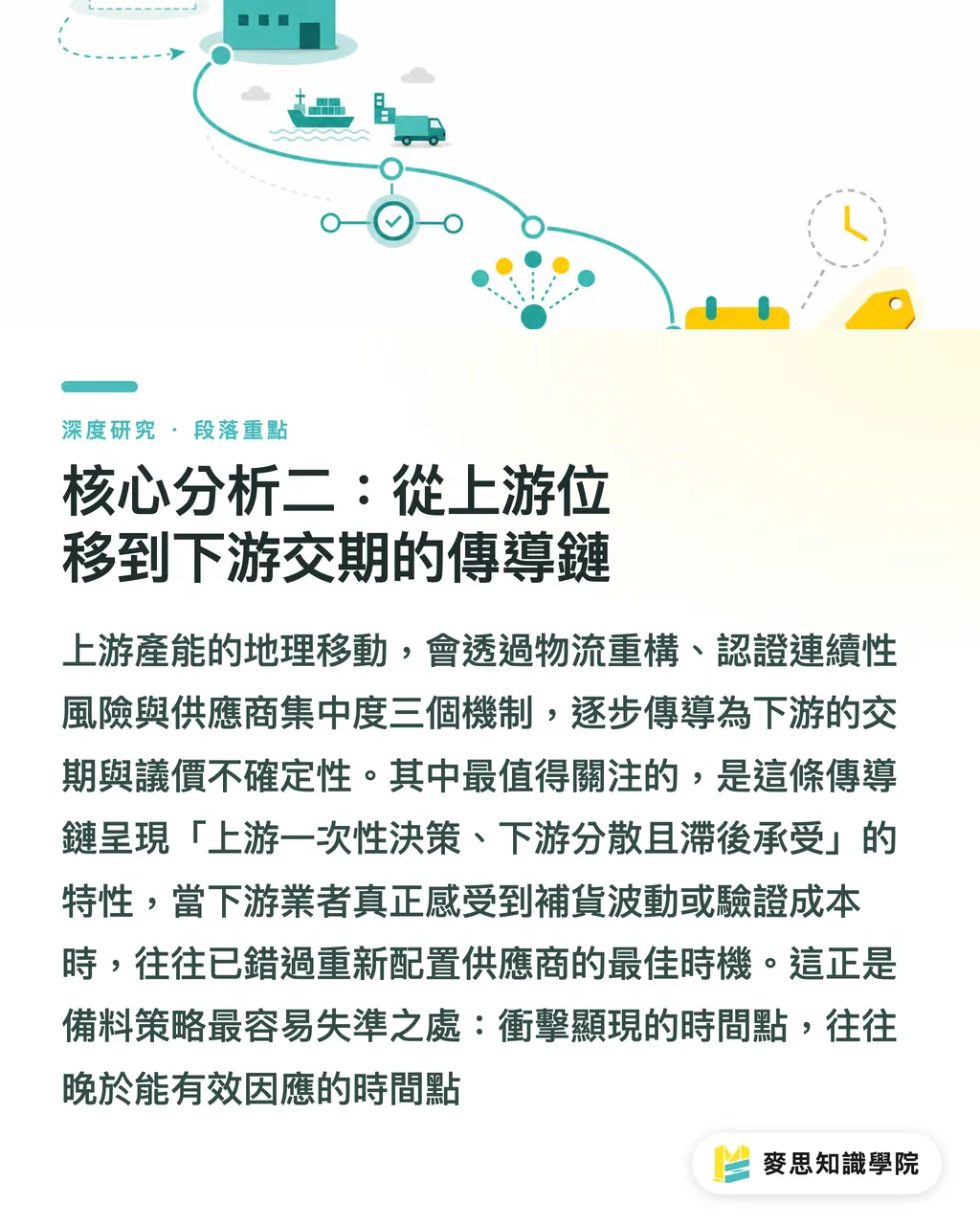
Core Analysis Three: Structural Pressures on European Ink Manufacturing and Consolidation as Norm
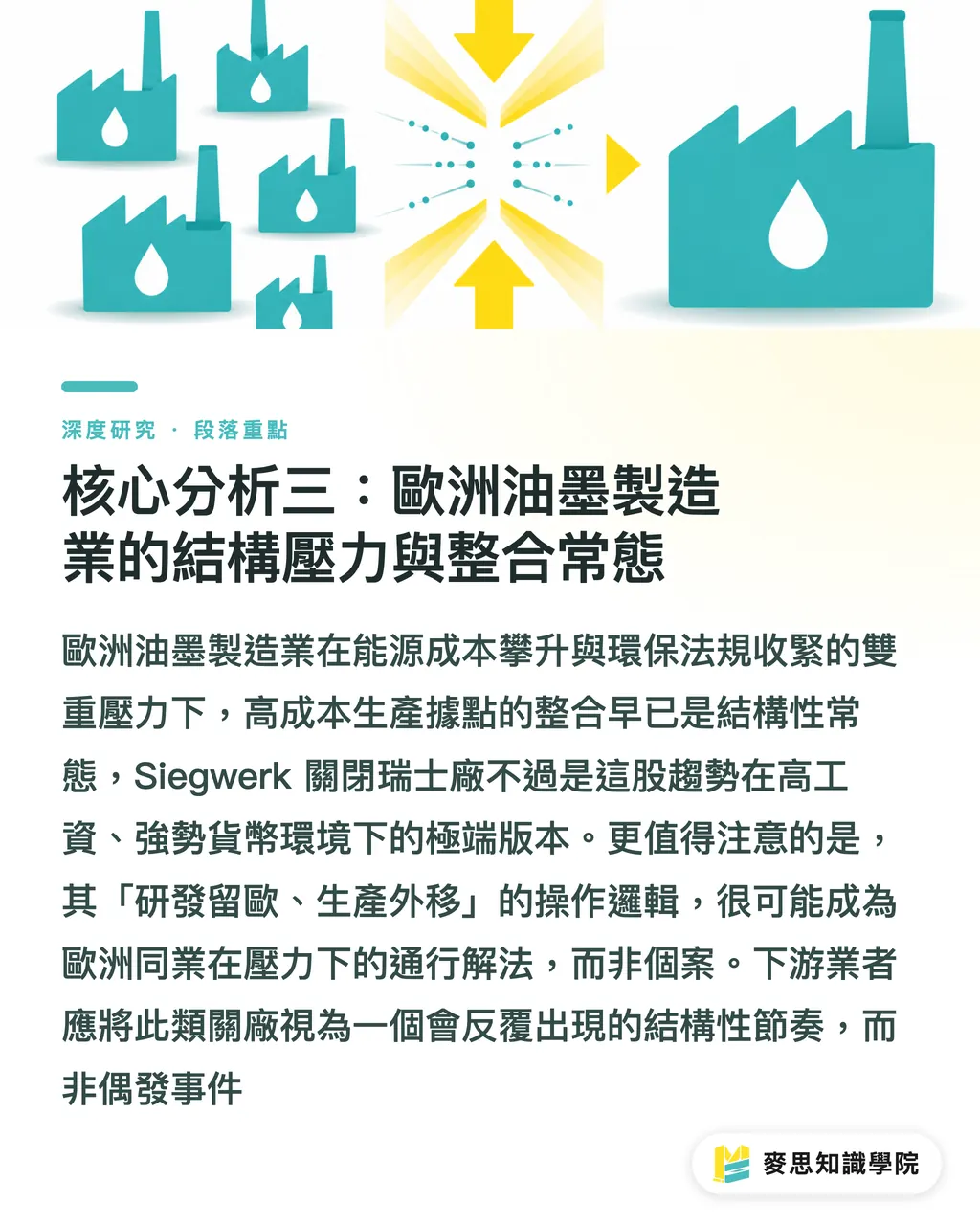
This section argues that Siegwerk's plant closure should be understood as a consolidation norm under overall pressure on European ink manufacturing, not a singular event by one company
From the cost side, European ink manufacturing simultaneously bears dual pressure from energy costs and environmental regulations. This structural backdrop makes the continuity of high-cost facilities increasingly difficult, and Siegwerk's cited Swiss costs and franc strength represent an extreme version of this universal pressure in a specific country [1]. This article's analysis argues that Switzerland, being outside the eurozone and characterized by high wages and a strong currency, often becomes the first production location examined under such cost pressure
From industry governance perspective, Siegwerk has long been deeply involved in European industry organizations, with its former CEO serving as EuPIA chair [3], showing that Europe has traditionally been its technical and policy authority base. The choice to "retain Swiss technical operations while remove production" [1] can precisely be read as a compromise between maintaining Europe's technical legitimacy and reducing European production costs. This article's analysis argues that this "R&D stays in Europe, production relocates" pattern may become a typical solution for European ink operators under pressure
From historical comparison, Siegwerk's two decades of mergers and expansion [2][6] show its habit of responding to market shifts through structural adjustment. This plant closure in nature is part of the same lineage as past acquisitions [6] and new market entry [2][5]—all expressions of the same "continuous reorganization to align with growth markets" corporate behavior, only now shifting direction from expansion to consolidation. This article therefore argues that downstream should not view a single closure as contingent but as a structural rhythm that will recur
This section's limitation is that the pressures constituted by energy costs and environmental regulations are general industry judgments made based on sectoral context by this article, while first-hand sources only explicitly cite costs, exchange rates, and demand as three drivers [1] and do not quantify the weight of each pressure. Thus this article's assertion of "consolidation as norm" is trend-level interpretation rather than quantitatively verifiable conclusions
Implications for Taiwan's Design and Printing Industry
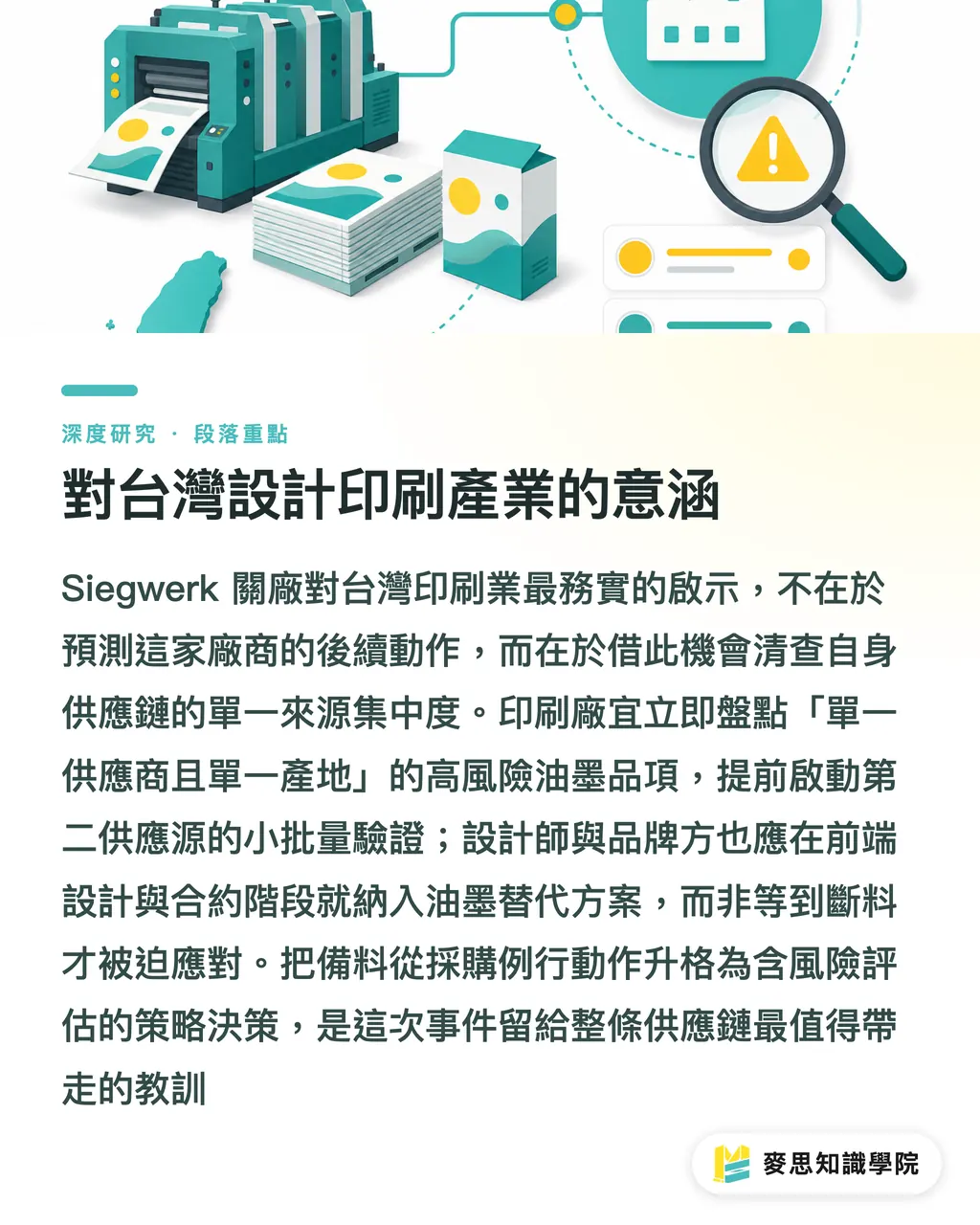
This section argues that the most pragmatic value of this event for Taiwan's industry lies not in predicting Siegwerk's next moves, but in catalyzing a systematic audit of single-source risk. The following outlines actionable approaches for three stakeholder categories
For small and medium-sized printing and flexible packaging operators, a three-step approach is recommended. Step one is inventory: list all critical ink products, noting supplier, sourcing location, and whether qualified alternatives exist; flag any items with "single supplier and single sourcing location" as high-risk [1]. Step two is buffering: for high-risk specialty inks with long lead times (such as food-safe grades, solvent-free UV), increase safety stock levels within cash flow tolerance, and revise lead time assumptions toward "conservative during transition periods." Step three is alternative validation: proactively launch small-batch validation of secondary suppliers for critical items, front-loading the time cost of certification and sampling rather than waiting until shortage to begin
For designers and design studios, the implication is that front-end design phases should consider ink availability. This article's analysis argues that when the supply stability of certain specialty inks declines, design input can lower the risk of forced revisions due to shortage if it preserves alternative options in color, surface treatment, and material selection. In pricing and schedule communication, it is prudent to incorporate "specialty inks may face extended lead times" into timeline representations to clients, avoiding commitment to delivery times that cannot be guaranteed
For brand owners, the implication is incorporating ink supply risk into risk management for packaging and printing outsourcing. Concrete approaches include: clarifying in contracts with printing suppliers the responsibility attribution for lead time changes; for products highly dependent on specific specialty ink effects (such as particular metallic finishes, solvent-free food-safety specifications), pre-confirming with supply chain the visual and compliance equivalence of alternatives. This article's analysis argues that while brand owners are furthest from the upstream, they often suffer the largest losses when shortages cause market delays, thus warrant proactive involvement
The shared learning across stakeholder roles is: upgrade "inventory management" from a routine procurement activity to a strategic decision incorporating risk assessment. Siegwerk's adjustment matters to Taiwan operators not because it directly cuts anyone's supply, but because it is a low-cost reminder—allowing downstream to re-examine its supply chain concentration before getting hurt [1]
Conclusion and Limitations
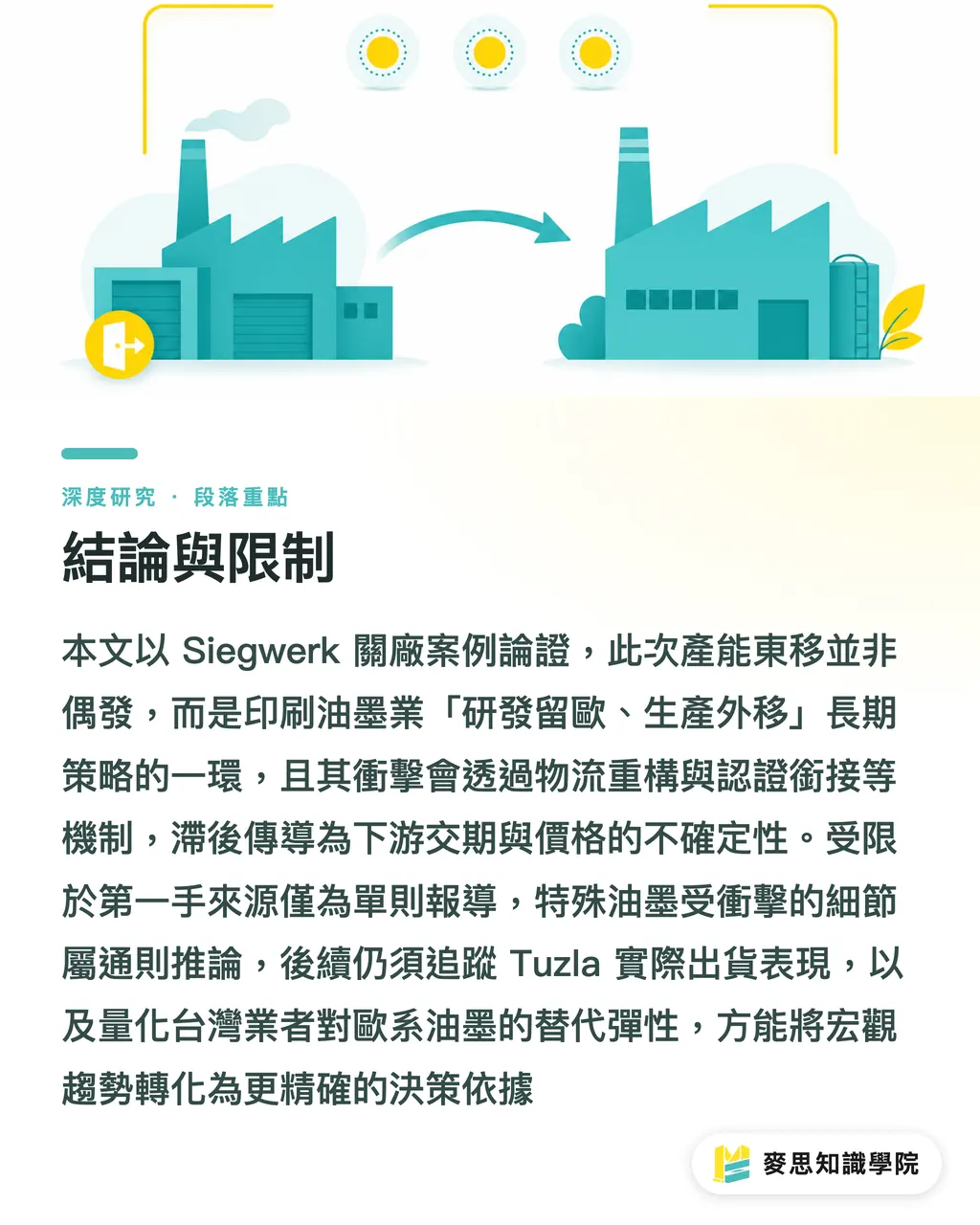
This article used Siegwerk's closure of its Swiss Bargen facility and capacity transfer to Tuzla, Turkey [1] to address the three questions posed in the introduction. On the first question, through long-term literature comparison [2][3][4][5][6], this article argues that the closure is a continuation of the group's long-term strategy of "aligning gravity with growth markets," not a contingent decision. On the second question, this article proposes three mechanisms—logistics reconfiguration, certification continuity, and supplier concentration—explaining how upstream shifts transmit downstream with lag and dispersion as delivery time and price uncertainty. On the third question, this article proposes layered audit, buffering, and alternative validation approaches, translating macro events into actionable decisions for three categories of Taiwan industry players
This article must candidly disclose several limitations:
・First, the first-hand source is a single industry report, providing only employment and capacity figures for Tuzla (2020 capacity up 20%, added 20 jobs, total headcount 130) and three closure drivers [1], not covering specific affected product lines; thus this article's discussion of specialty ink impacts represents general inference rather than reported fact
・Second, structural pressures from energy costs and environmental regulations represent this article's interpretation based on sectoral background, not quantified for each item
・Third, cited historical literature largely clusters around 2004–2009 [2][3][4][5][6], with time gaps relative to current conditions, supporting only trend-level comparison and not suitable for inferring recent details
Three directions for follow-up research exist: first, tracking actual post-Tuzla export lead times and quality consistency to validate this article's transmission mechanism; second, quantifying Taiwan's high-end printing and packaging sector's reliance on European specialty inks and substitution elasticity; third, comparing capacity allocation dynamics of other major ink manufacturers to test whether "R&D stays in Europe, production relocates" has become industry norm
Key Takeaways
・Siegwerk closes Swiss Bargen facility and transfers production to Tuzla, Turkey, driven by high costs, strong Swiss franc, and declining market demand for certain inks, affecting over one hundred positions
・Tuzla facility underwent major modernization in 2020 with 20% capacity increase, indicating eastward capacity migration is long-term strategy, not hasty cost cutting
・Upstream shifts transmit downstream through logistics reconfiguration, certification continuity, and supplier concentration mechanisms, with lead times and pricing uncertainty lagging and dispersed
・Taiwan operators' practical value lies in auditing single-source risk: flagging "single supplier and single location" critical inks and proactively launching alternative validation
・First-hand source does not specify affected product lines; specialty ink impacts are general inference; operators should respond with strategic inventory management rather than panic hoarding
Extended Reflection
For printing manufacturing and design, the true lesson of this closure is not "European inks will get expensive," but rather that supply chain concentration itself is a risk to be managed, warranting simultaneous attention across procurement, design, and pricing decision-making. For AI and SaaS implications: if ink and consumables supplier, location, certification, and lead time data could be structured, it could support automated single-source risk alerting and alternative product recommendation, translating judgments currently scattered across procurement staff experience into system-trackable indicators. The open question is how, without relying on upstream voluntary disclosure, to detect supply gravity shifts early—a challenge that the next generation of supply chain resilience tools must answer
References
[2] Siegwerk Gains Major Foothold in India. Pigment & Resin Technology. DOI: 10.1108/prt.2008.12937bab.015
[3] Siegwerk CEO Herbert Forker elected Chairman of EuPIA. Pigment & Resin Technology. DOI: 10.1108/prt.2008.12937dab.004
[4] Siegwerk starts volume production for waterless web offset. Pigment & Resin Technology. DOI: 10.1108/prt.2008.12937eab.020
[5] Ink, Heart & Soul from Siegwerk South Africa. Pigment & Resin Technology. DOI: 10.1108/prt.2009.12938dab.015
[6] Siegwerk acquires Color Converting Industries00226-7). Focus on Pigments. DOI: 10.1016/s0969-6210(04)00226-7
CCF
- Why did Siegwerk close its Swiss facility?
- According to first-hand reporting, the primary reasons are high Swiss production costs, erosion of competitiveness from a strong Swiss franc, and declining demand in some printing ink markets; the group concentrated production at Tuzla, Turkey, to more cost-effectively serve Eastern Europe, the Middle East, and Africa
- Will this closure directly impact Taiwan's ink supply?
- First-hand sources do not specify which product lines are affected, so direct shortage cannot be confirmed. However, for Taiwan operators reliant on single European suppliers from single locations, delivery time and pricing uncertainty may increase during the transition period; proactive risk auditing is warranted
- How should Taiwan printing facilities respond to such upstream closure events?
- A three-step approach is recommended: first audit all critical inks for supplier and location, flagging single-source high-risk items; second increase safety stock for long-lead specialty inks; third proactively launch small-batch validation of secondary suppliers for critical items
- Can the Tuzla facility absorb capacity transferred from Switzerland?
- Yes. The Tuzla facility underwent major modernization in 2020 with 20% capacity increase and added positions, reaching 130 total staff, indicating absorption was a multi-year strategy rather than emergency improvisation
- Is Siegwerk completely withdrawing from Switzerland?
- No. Reports indicate the group only transferred production while retaining technical operations in Switzerland, showing a selective convergence model of "R&D stays in Europe, production relocates."
Ailt ghaolmhara
- Tar éis dearadh an chárta gníomhaíochta a chríochnú, conas a théann tú i ngleic le comhad ionas nach mbeidh sé basctha agus á phriontáil?
- Scaoileadh agus Limistéar Slán: Cé mhéad ar chóir a fhágáil ar do chóipeanna priontála ionas nach scoiltear iad
- Conas a Roghnú Méideanna Postéirí Coitianta sa Tadhbhlúr? Caighdeáin Chlóbhuailte A0/8K/4K Mínithe go Soiléir