

What is the optimal resolution for large format printing to avoid blurriness?
The most common disaster I see on the production line is designers sending a 3-meter-long poster at 300 dpi
Such files not only crash your computer but also place unnecessary burden on the printer
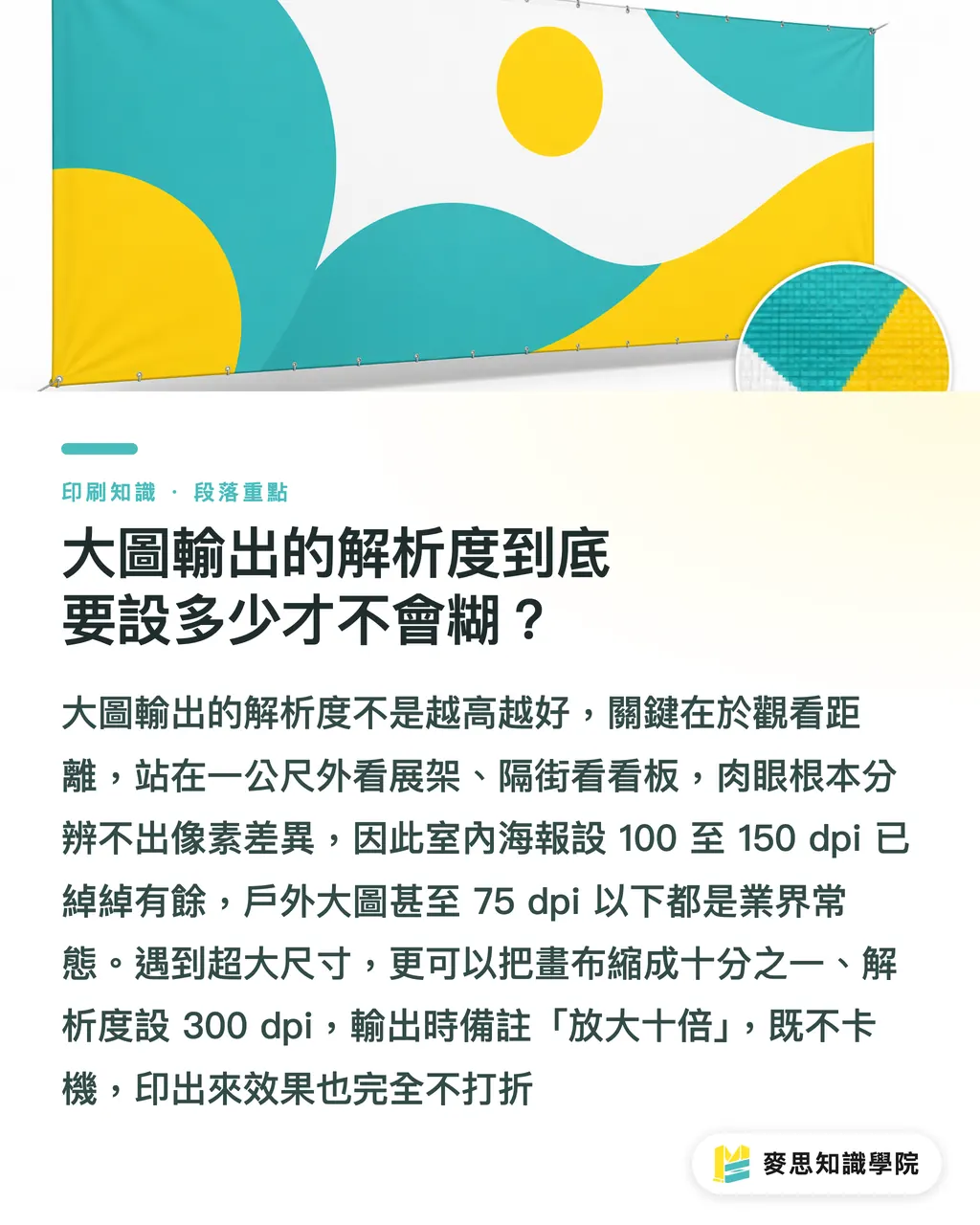
While business cards or brochures held in hand require 300 dpi for detail, the core logic of large format printing is that 'viewing distance determines resolution'
When a viewer is standing a meter away from an X-stand, or looking at a billboard across the street, the eye simply cannot distinguish those tiny pixel differences
・Close-up viewing (e.g., indoor posters, display stands): Setting it to 100 to 150 dpi is perfectly clear
・Long-distance viewing (e.g., outdoor banners): Dropping to 75 dpi or even lower is standard in the industry
・File setup for giant sizes: For super-large billboards, you can directly scale the canvas down to 1/10th in the software and set the resolution to 300 dpi
・Before sending, just note 'Scale up by 10x for original size'. After the machine scales it, the actual output is 30 dpi, easily solving the issue of massive files freezing the system
How to choose materials for indoor displays and outdoor billboards?
Whenever a client asks me which material to choose for large format printing, I always ask three questions first: what is the size, where is it being placed, and how long will it be used?
The cost of choosing the wrong material is high; fading within a week outdoors or adhesive residue stuck on the wall upon removal are painful lessons paid for in cash
Understanding the characteristics of these common materials covers over 90% of use cases
・Outdoor durability pick: PVC banner with anti-UV ink, weather-resistant, sun-proof, and waterproof, suitable for building facades and street ads
・Indoor pop-up applications: PP photo paper or synthetic paper, which has a smooth surface and excellent color saturation, usually protected with a matte or glossy film, perfect for X-stands and pull-up banners
・Smooth wall wrapping: PVC self-adhesive has strong adhesion and sticks flat, but if there is a need for short-term replacement, be sure to confirm with the vendor if you need to use a low-residue adhesive material
・Integrated 3D displays: Once printed, the paper or self-adhesive can be mounted on foam board or synthetic board, and its rigid nature makes it perfect for photo-op props or 3D lettering
Essential error-proofing and file verification before sending to print
Looking perfect on screen but missing text or getting cropped during printing is the most common lament I've heard in over a decade in the industry
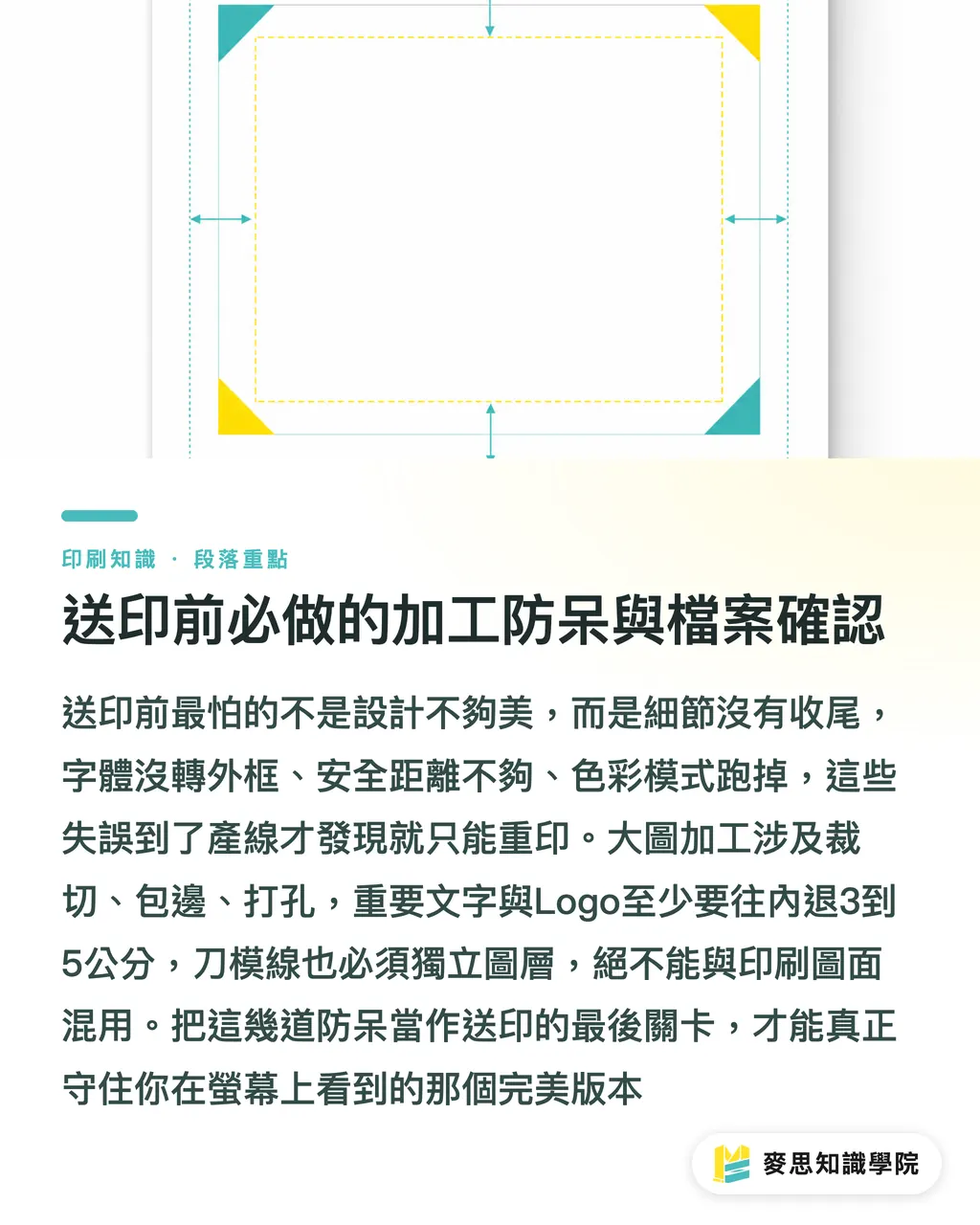
Post-processing for large format is far more complex than standard printing; from cutting, edge-folding to eyelet punching, every action will eat into the edges of your image
Treating these actions as your final defense line before printing can stop common production-end disasters
・Always convert fonts to outlines: Just like business card printing, not converting fonts to curves is a big taboo. As large files travel between different computers, the risk of missing fonts or character shifting is much higher
・Leave extreme safety margins: While business cards need a 3mm bleed, large format (especially banners) often requires edge folding and eyelet punching; important text and logos should be pushed at least 3 to 5 cm inward to be safe
・Confirm color and size markings: Keep files in CMYK color mode and clearly state the 'actual final output size' and 'scaling ratio' on the file name or order form
・Clarify cutting and mounting needs: If you have additional die-cutting or mounting requirements, be sure to create a separate die-cut line layer in the file and never mix it with the print layer
Key takeaways
・Viewing distance determines large format resolution; 75 dpi is sufficient for distance viewing. Flexibly use 1/10 scaling to save computer performance
・For outdoor durability, choose banners with UV ink; for indoor color vibrancy, choose PP photo paper. Use the three variables of 'size, location, time' to narrow down material options
・Large format post-processing consumes edges; important visuals and logos must be pushed inward by 3 to 5 cm to avoid eyelet punching and edge folding
・Strictly convert fonts to outlines before sending files, and clearly label the final output's actual ratio and dimensions in the filename
Further reflection
Many people think large format printing is just magnifying small files infinitely, but it is actually the first encounter between graphic design and physical space
From my accumulated production line experience, the best practice is to bring in a printing consultant during the sketch phase to discuss
Teams with integrated capabilities like [MINDS](URL) can help you avoid landmines like incompatible materials or processing that ruins the visual ahead of time
Handing these troublesome physical variables to professionals allows designers to focus on perfecting the visual
FAQ
- How is large format printing different from standard poster printing?
- Standard printing uses 300 dpi for close-up details, while large format printing is intended for greater viewing distances, so a resolution of 75 to 150 dpi is sufficient. Furthermore, materials are mostly non-paper carriers with waterproof or weather-resistant properties
- What should I do if the file for a large outdoor banner is too big and lags?
- Scale your canvas down proportionally to one-tenth of the original size and set it to 300 dpi. Note 'scale up by 10x for original size' when sending to print. The machine will actually output at 30 dpi, resulting in a crisp image and a tiny file size
- Which material is recommended for X-stands and pull-up banners to look the best?
- The most common and effective choice is PP photo paper or synthetic paper, which has a smooth surface and excellent color performance. It is usually recommended to pair it with a glossy or matte film to increase protection and texture
- How much safety margin should be left at the edges of a large format file?
- Unlike business cards which only need a 3mm bleed, if large formats require edge-folding or eyelet-punching (like attaching rings), important content should be at least 3 to 5 cm away from the edges to avoid being ruined