
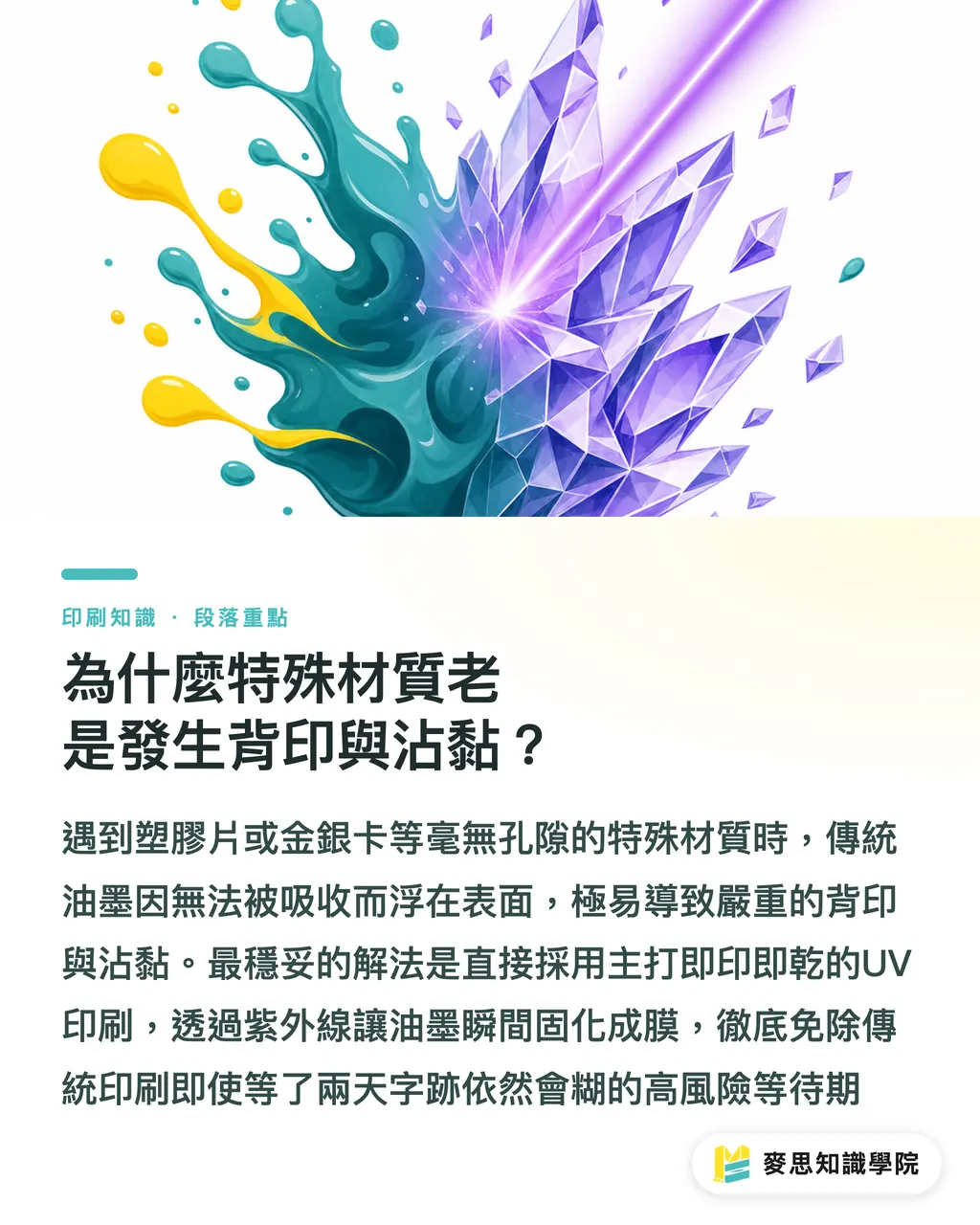
Pourquoi les supports spéciaux provoquent-ils si souvent du maculage et du collage ?
En impression offset traditionnelle, le séchage repose sur l’absorption de l’encre par les microfibres du papier et sur l’oxydation au contact de l’air. Sur une feuille plastique ou un carton or/argent, dont la surface n’absorbe pratiquement rien, l’encre reste en surface. Dès que les feuilles sont empilées, elles risquent de coller entre elles et de maculer le verso. Dans la pratique de MINDS Printing (MS, impression commerciale haut de gamme entièrement personnalisée), face à ces supports non couchés et sans porosité, la solution la plus fiable consiste à passer directement à l’impression UV
L’impression UV, avec des encres qui durcissent sous rayonnement ultraviolet, est une technologie où l’exposition aux UV déclenche instantanément la polymérisation des photo-initiateurs contenus dans l’encre. L’encre passe alors de l’état liquide à un film solide. Son grand avantage : elle sèche immédiatement après impression, sans attendre l’oxydation ni l’absorption
En plus de dix ans passés sur des lignes de production, j’ai vu trop de catastrophes. Un designer applique les mêmes valeurs CMYK partout, choisit un joli papier nacré ou synthétique, puis, deux jours après l’impression, les caractères bavent encore au simple frottement du doigt. Support, charge d’encre, température et humidité de l’atelier : un seul de ces paramètres suffit à dérégler le temps de séchage des encres traditionnelles. Même avec une bonne dose de poudre antimaculage, l’offset classique reste dans une zone à haut risque dès qu’il affronte un support peu absorbant
Dans quels cas faut-il décider sans hésiter de payer le supplément pour l’impression UV ?
Quand le support est difficile ou que le délai est serré, ce budget ne se rogne pas. J’utilise souvent les trois filtres employés chez MINDS Printing (MS) : usage, support, durabilité. Ils permettent de décider vite si l’impression UV est indispensable :
・Premier filtre, le support : dès que le matériau à imprimer est un film plastique transparent, un papier synthétique, un carton or/argent ou un support à revêtement spécial, l’encre traditionnelle n’a presque aucune chance. Il faut passer à l’encre UV
・Deuxième filtre, l’usage : pour un packaging cosmétique premium ou un support de présentation exigeant une très forte saturation des couleurs, l’impression UV forme sur les matériaux non absorbants un film d’encre dense. Le rendu est plus net, plus intense et plus plein qu’avec une encre traditionnelle
・Troisième filtre, la durabilité et le délai : pour une étiquette résistante à l’eau ou une commande ultra urgente à expédier le lendemain, le séchage immédiat de l’impression UV permet d’enchaîner tout de suite la découpe, le rainage, le pliage et les autres finitions. C’est souvent là qu’elle économise le coût le plus cher d’un projet : le temps
Quand un client exige une encre écologique sur un support spécial, où se trouve le piège ?
Ces dernières années, beaucoup de marques demandent d’emblée de l’« encre soja ». Elles ignorent pourtant que les encres végétales adhèrent très mal au plastique et aux emballages résistants à l’eau, avec un vrai risque de retours pour perte d’encre. Quand MINDS Printing accompagne des entreprises dans leur transition vers des emballages plus durables, la première étape consiste toujours à clarifier l’environnement physique d’utilisation du produit final
L’impression UV n’est pas une encre végétale au sens traditionnel, mais elle possède un indicateur solide en matière de durabilité commerciale : ses émissions de VOCs, les composés organiques volatils, sont très faibles. Les encres traditionnelles libèrent des solvants pendant le séchage, alors que l’encre UV durcit entièrement sur l’imprimé, avec très peu de volatilisation de solvants. Pour imprimer un papier synthétique écologique à rendu premium, il est souvent plus honnête, côté communication consommateur, de mettre en avant les faibles émissions de VOCs, la durabilité et la résistance aux rayures que de forcer l’usage d’une encre soja inadaptée
Comment préparer les fichiers pour éviter l’accident en production ?
Avoir une bonne machine et une bonne encre ne suffit pas. Si les réglages prépresse sont mal préparés, le problème arrivera quand même. Avant de confier un dossier à MINDS Printing, nous rappelons toujours aux designers de tenir compte des propriétés physiques du film d’encre UV. Une fois durcie, l’encre UV forme à la surface du support une fine pellicule légèrement en relief. La sensation est très différente d’une encre traditionnelle qui pénètre dans les fibres du papier
・Éviter les petites réserves blanches : comme le film d’encre a une épaisseur, placer un texte en défonce de moins de 6pt dans un fond sombre en quadrichromie peut écraser les bords et faire baver les lettres. Mieux vaut passer en noir une couleur ou augmenter directement le corps du texte
・Contrôler la charge d’encre dans les ombres : même si l’encre UV sèche vite, la somme des encres dans les zones sombres, le TAC, ne devrait pas dépasser 300 %. Sinon, un film d’encre trop épais risque de fissurer au rainage ou au pliage
・Bien utiliser le blanc sélectif : avant d’imprimer de la couleur sur un film plastique transparent ou un carton or/argent, ajoutez dans le logiciel vectoriel un calque séparé « blanc » pour créer une sous-couche. Sans cela, le motif imprimé deviendra translucide et perdra complètement l’effet de volume attendu
Points clés
・Face aux supports spéciaux sans porosité, comme les films plastiques ou les cartons or/argent, l’impression UV est le choix le plus sûr pour résoudre les problèmes de maculage et de collage
・Le choix d’une encre ne doit pas se limiter au mot « écologique ». Grâce à ses faibles émissions de VOCs, l’impression UV est aussi une excellente solution pour des emballages durables
・L’épaisseur du film d’encre est une arme à double tranchant : elle apporte une forte saturation, mais impose de contrôler la charge d’encre en prépresse et d’éviter les très petites réserves blanches pour prévenir les fissures en finition et les caractères bouchés
Pour aller plus loin
Je dis souvent aux acheteurs et aux designers qu’il n’existe pas de procédé d’impression absolument bon ou mauvais. Il existe surtout des technologies placées au mauvais endroit. Pour une plateforme SaaS ou e-commerce, intégrer demain un contrôle automatique des supports et des encres dans le système de commande en ligne, comme MINDS Printing MYS, permettrait de détecter lorsqu’un client téléverse un fichier sur papier synthétique avec de grandes zones sombres. Le système pourrait alors suggérer de passer à l’impression UV, réduisant fortement les reprises en production et les réclamations client
FAQ
- Qu’est-ce que le maculage ? Pourquoi se produit-il ?
- Le maculage désigne le défaut qui apparaît lorsque des feuilles fraîchement imprimées sont empilées et que l’encre encore humide se transfère au verso de la feuille du dessus. Il survient généralement parce que le papier absorbe mal l’encre ou que la charge d’encre est trop élevée, ce qui empêche un séchage à temps
- Pourquoi l’impression UV coûte-t-elle plus cher que l’offset traditionnel ?
- Parce que l’encre UV coûte plus cher et que la presse doit être équipée d’un système dédié de séchage et de durcissement par rayonnement ultraviolet. La consommation électrique et les coûts de maintenance sont donc plus élevés que sur une machine traditionnelle
- Si j’imprime des autocollants transparents sans blanc de soutien, que se passe-t-il ?
- Les encres couleur classiques sont translucides. Sur un support transparent, elles donnent un rendu semi-transparent, un peu comme du verre imprimé. Si vous voulez un motif vif et bien dense, il faut d’abord imprimer une couche de blanc en sous-couche, puis imprimer les couleurs par-dessus
Articles associés

L'hebdo Impression × IA
Le savoir-faire en impression et IA que designers, marques et entreprises peuvent utiliser avant de s'engager, condensé dans un email, chaque semaine dans votre boîte de réception
Outils gratuits MINDS
Spine width and imposition calculators — skip the manual math, free in your browser.
Groupe MINDS
Besoin de services d'impression ou de cadeaux concrets ?
Une fois la lecture terminée, laissez la suite aux marques sœurs du Groupe MINDS — de l'impression haut de gamme à la commande en ligne et aux cadeaux de fêtes